Chapter 2 · Vehicle knowledge and handling · 5 min
Bus dimensions and speed
A bus is a large vehicle that has to make its way along the same roads as cars. That is why there are rules on how big it may be and how fast it may be driven. The speed rules are also linked to passenger safety: a bus where everyone has a seat belt may be driven faster than a bus where passengers lack seat belts.
Width and height
A bus may be no more than 2.55 metres wide if it is to be driven on roads other than private roads (enskilda vägar) (Traffic Ordinance (trafikförordningen) 4 kap. 15 §). That is 5 centimetres narrower than the limit for lorries.
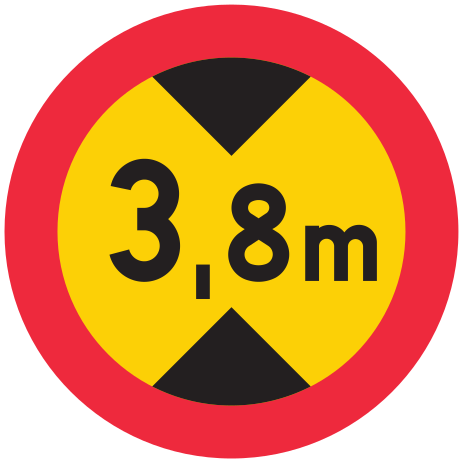
There is no general height limit in the Traffic Ordinance. You must know yourself how high your bus is, especially if you drive a double-decker, which is considerably higher than an ordinary bus. The sign for limited vehicle height always applies. Never try to get under an obstacle by lowering the bus with the kneeling system (nigningssystemet). Kneeling is for bus stops.
Length
Trafikförordningen 4 kap. 17 a § sets the maximum permitted length for different types of bus:
| Type of bus | Maximum length |
|---|---|
| Bus with two axles | 13.5 m |
| Bus with more than two axles | 15.0 m |
| Articulated bus with one articulated section | 18.75 m |
| Articulated bus with more than one articulated section | 24.0 m |
| Bus with a trailer for carrying passengers | 24.0 m |
| Bus with another kind of trailer | 18.75 m |
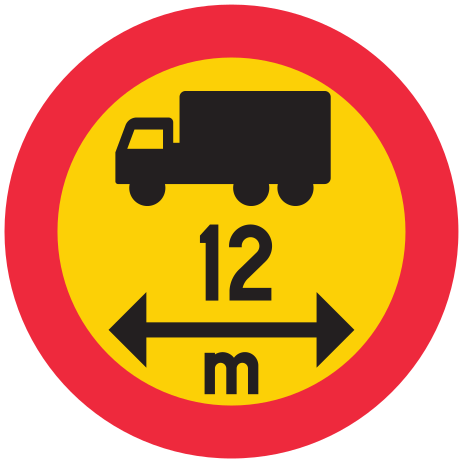
The sign for limited vehicle length applies both to vehicles and to vehicle combinations. So if you are driving a two-axle bus of 13.2 metres, you may not pass a sign showing 12 metres.
Weight
A heavy bus (tung buss) has a gross vehicle weight (totalvikt) of more than 3.5 tonnes. According to Transportstyrelsen's (the Swedish Transport Agency's) summary Lasta lagligt, a bus with two axles may have a gross weight (bruttovikt) of no more than 19.5 tonnes on roads in bearing capacity classes (bärighetsklass) 1 and 2. A bus powered wholly or partly by alternative fuel may weigh up to one tonne more, or two tonnes if it is zero-emission, if the technology requires the extra weight. The bus's gross vehicle weight and axle distances are stated in the registration certificate (registreringsbeviset).
Speed for heavy buses from 1 December 2026
On 1 December 2026 a new 4 kap. 20 § of the Traffic Ordinance comes into force (SFS 2026:1052). For buses the following apply:
- Heavy bus where everyone over the age of three has access to a seat with a seat belt: no more than 100 km/h.
- Other heavy bus: no more than 90 km/h.
- Articulated bus with more than one articulated section: no more than 60 km/h.
- Bus with a trailer for carrying passengers: no more than 60 km/h.
- Bus with another kind of trailer that has effective brakes operated from the service brake (färdbromsen): no more than 80 km/h.
The seat belts decide whether you may drive at 100
The 100 km/h limit requires that all passengers over the age of three have access to a seat with a seat belt (bilbälte). If any of them do not, for example because there are seats without belts or because passengers have to stand when all the belted seats are taken, a maximum of 90 km/h applies.
This means that as the driver you need to think about speed as soon as passengers get on. If the bus is approved for standing passengers and someone has to stand, you lower your maximum speed to 90 km/h.
The vehicle limit is a ceiling
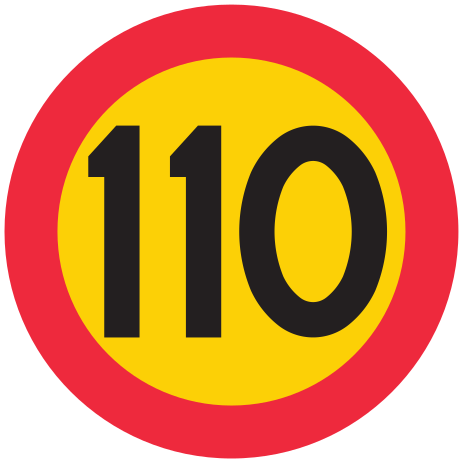
The bus's speed limit is the highest speed you may ever drive. It never gives you the right to drive faster than the road allows. If the road is signed 70 km/h, 70 km/h applies. If the motorway is signed 110 km/h, your vehicle limit of 100 or 90 km/h still applies.
Also remember that speed must always be adjusted to the conditions. With standing passengers, in bends and on slippery roads, the right speed can be considerably lower than the limit.
Bus with a trailer
With D or D1 you may tow a light trailer of no more than 750 kg. Heavier trailers require DE or D1E. For vehicle combinations with a bus the following apply:
- A luggage trailer with effective brakes operated from the bus's service brake gives a maximum speed of 80 km/h.
- A trailer intended for carrying passengers always gives a maximum of 60 km/h, even if the brakes meet the conditions for 80 km/h.
- A bus with a trailer for carrying passengers may be no more than 24.0 metres long. With another kind of trailer the limit is 18.75 metres.
Remember
- The maximum width of a bus is 2.55 metres.
- Length: 13.5 m with two axles, 15.0 m with more axles, 18.75 m for an articulated bus and 24.0 m for an articulated bus with several joints.
- Heavy bus: 100 km/h if everyone over three has access to a seat belt, otherwise 90 km/h.
- Articulated bus with more than one joint and bus with a passenger trailer: no more than 60 km/h.
- Bus with a braked luggage trailer: no more than 80 km/h.
- The vehicle limit is a ceiling. A lower signed speed always applies.
- The kneeling system is for bus stops. Never use it to get under low obstacles.