Chapter 4 · Traffic safety · 6 min
Riding technique and risks
Motorcycling gives freedom and joy, but the margins are small. You have no car body around you, and even at a legal speed an accident can have serious consequences. The good news is that many accidents can be avoided with the right technique, the right tactics and an honest approach to your own limitations.
Where do the accidents happen?
Trafikverket's (the Swedish Transport Administration's) analyses of accidents in which motorcyclists have been killed show a clear pattern:
- Single-vehicle accidents (singelolyckor) are the most common type of accident, that is, accidents where the motorcyclist leaves the road or falls without colliding with anyone else.
- Junction accidents (korsningsolyckor) are the second most common.
- The most common place for motorcycle accidents is bends.
- Only three in ten motorcyclists who have been killed were judged to have been keeping to the speed limit.
Speed is therefore a key factor. It can both cause the accident and make the injuries worse.
Sobriety is another. Never ride a motorcycle after drinking alcohol or taking drugs. The limit for drink-driving (rattfylleri) is 0.2 promille, and narcotic drugs in the blood are always drink/drug-driving unless they are medicines taken as prescribed (Act on Penalties for Certain Traffic Offences, lag 1951:649 4 §).
Technique and tactics
It is not enough to be able to handle the motorcycle. You also need tactics (taktik), that is, making wise decisions in traffic so that you never have to brake harder than you had planned. Tactics is about how much time you need, which area you should keep watch over and what distance you should keep.
Distance. With a longer distance to the vehicle in front, you get more time to react. You do not need to brake as hard if it brakes.
Positioning. Usually it is safest to ride in the middle of your part of the road. Choose your position before you enter a situation and adjust it when oncoming traffic or obstacles appear.
Riding position
The aim of the riding position (körställning) is to sit well anchored on the motorcycle. Sit where the rider's weight is intended to be. Keep in contact with the motorcycle with your lower body, for example by gripping the tank lightly with your knees. Be relaxed from the hips upwards, so that your hands can work the controls smoothly. You should not hang on the handlebars.
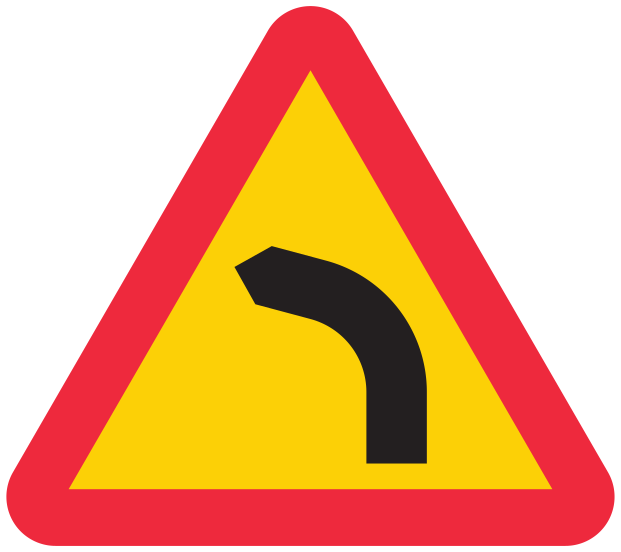
Bends
Because bends are the most common place for accidents, cornering technique is crucial.
- Adjust your speed before the bend, not in it. Finish braking while the motorcycle is upright.
- Look as far ahead as you can and look where you want to go.
- Keep to the right of your part of the road on blind bends and crests. Oncoming traffic may come in the middle of the road.
- Adjust your speed so that you can stop within the distance you can see.
- Countersteering (motstyrning) is used to lean the motorcycle into the bend. A light forward push on the right handlebar grip makes the motorcycle lean to the right, and vice versa. Countersteering is also what you use in a quick evasive manoeuvre.
With a clear view and no oncoming traffic you can use more of the road surface, but avoid drifting out unintentionally. Position and speed must always be a conscious choice.
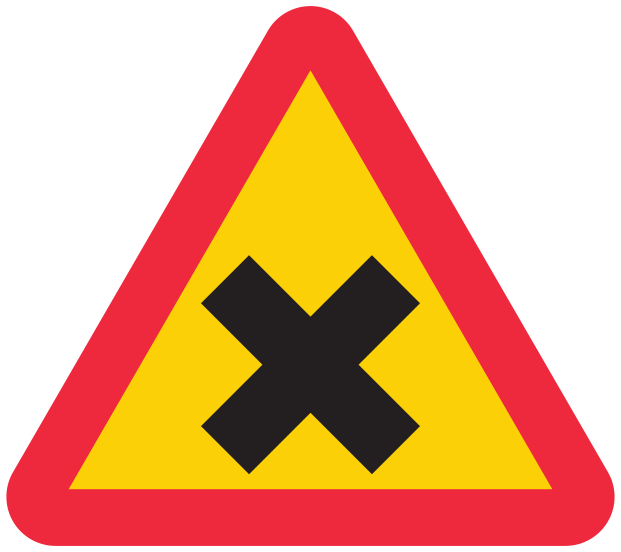
Junctions
Assume that others do not see you. A motorcycle is narrow and can be hard to spot, and car drivers find it hard to judge its speed. Therefore:
- Adjust your speed when approaching a junction with poor visibility.
- Expect that a car waiting on a side road may pull out in front of you.
- Keep a sideways margin and be prepared to brake.
- Be extra alert at exits with obstructed visibility.
Being seen in traffic
Other road users find it hard to see motorcycles. This is one of the subjects covered by the risk education (riskutbildning). What you can do:
- Use dipped headlights, which are compulsory.
- Choose clothes and a helmet that are visible.
- Avoid staying in other vehicles' blind spots, for example next to a heavy lorry.
- Position yourself so that you are visible in the mirrors of the car in front.
Lanes, queues and overtaking
If lanes in the same direction are separated by road markings, the whole vehicle must be driven within one of the lanes. This also applies to motorcycles, so you may not ride on the line between two queues of cars (Traffic Ordinance (trafikförordningen) 3 kap. 9 §). Nor may you ride on the cycle track to get past a queue.
As a motorcyclist you may be overtaken even where overtaking is otherwise prohibited. The Traffic Ordinance says that two-wheeled vehicles without a sidecar may be overtaken at, for example, crests of hills and junctions (3 kap. 39 §). Be prepared for this and keep a safe position. If someone overtakes you, you must keep to the right and not increase your speed (3 kap. 38 §).
The road surface
The motorcycle has only two small contact patches with the road. Loose gravel, wet road markings, manhole covers, leaves and ruts in the asphalt can quickly reduce grip. Trafikverket mentions loose gravel as an example of problems with the road surface and highlights even and predictable friction as important for motorcyclists. Read the road surface, especially approaching and in bends.
Warning signs
Trafikverket lists signs that your riding is not going as planned. Take them seriously, because small warning signs can lead to discomfort, injuries and in the worst case a serious accident:
- Your position coming out of a situation was not what you had planned.
- You have to brake harder than you had decided.
- You release or lose the throttle in bends so that your riding becomes jerky.
- You have a higher speed going into a bend than coming out of it.
- You put your foot down to keep your balance even though you did not intend to stop.
- You hold on to the handlebars to balance your body.
If you recognise yourself: reduce your speed, increase your margins and practise more, preferably on a practice track.
Remember
- Single-vehicle accidents are the most common and junction accidents the second most common. Bends are the most common place for accidents.
- Only three in ten motorcyclists killed were judged to have been keeping to the speed limit.
- Tactics means that you should never have to brake harder than planned.
- Reduce your speed before the bend and adjust it so that you can stop within the distance you can see.
- Countersteering leans the motorcycle into the bend and is used in evasive manoeuvres.
- Assume that others do not see you at junctions.
- The whole motorcycle must be within one lane. No riding on the line between queues.
- Take warning signs such as jerky throttle control and unplanned hard braking seriously.