Chapter 3 · Rational driving · 6 min
Rational driving
Rational driving (rationell körning) means driving safely, economically and with care for the vehicle, all at the same time. It is the first main area of YKB training (direktiv (EU) 2022/2561 bilaga I, punkt 1). A driver who masters rational driving saves fuel, reduces wear and drives with larger safety margins. This benefits the environment, the company's finances and road safety alike.
The engine and the drivetrain
To drive fuel-efficiently you need to understand how the engine works.
- Torque (vridmoment) is the engine's "pulling power" and is measured in newton metres (Nm).
- Power (effekt) is how much work the engine can do per unit of time and is measured in kilowatts (kW).
- Engine speed (varvtal) is given in revolutions per minute (r/min).
A diesel engine generally works most efficiently at low engine speed and high load, close to the range where it delivers its maximum torque. That is where consumption per unit of work done is at its lowest. A high engine speed means more combustion strokes per minute and more internal friction, and therefore higher consumption.
In practice this means:
- Change up early and drive in as high a gear as possible without the engine labouring.
- Skip gears when the vehicle can manage it, for example when accelerating on a level road. This keeps the engine speed down and reduces the number of gear changes.
- Use the vehicle's rev counter and any economy indicators to keep the engine in the right speed range.
Nine steps to eco-driving
Energimyndigheten (the Swedish Energy Agency), citing Trafikverket (the Swedish Transport Administration) as its source, summarises eco-driving (sparsam körning) in nine steps. The steps are written for cars but largely apply to heavy vehicles too:
- Drive with anticipation and avoid unnecessary stops.
- Change up early and drive in as high a gear as possible.
- Keep an even pressure on the accelerator and keep to the speed limits.
- Use engine braking.
- Do not idle.
- Coast on downhill slopes and keep an even pressure on the accelerator uphill.
- Use an engine pre-heater.
- Service the vehicle regularly and check the tyre pressure.
- Remove anything that increases air or rolling resistance.
Some of the steps are especially important with a heavy vehicle. If you see a traffic signal far ahead turn red, lift off the accelerator early and let the vehicle roll. Every time you brake off speed, you have paid for it with fuel. On a long uphill slope it often pays to accept that the speed drops, rather than pushing on to maintain it.
Speed, air resistance and tyres
The faster you drive, the more fuel you use, and consumption rises noticeably with every 10 km/h. This is mainly due to air resistance (luftmotstånd), which increases sharply with speed and is one of the biggest factors behind a lorry's consumption at open-road speeds. Correctly adjusted wind deflectors and spoilers reduce air resistance.
The correct tyre pressure is one of the simplest ways to save fuel. The wrong pressure increases rolling resistance, wears the tyres unevenly and impairs road holding.
Also think about idling. Many municipalities have local rules on how long an engine may idle, and the rules differ between municipalities. Check what applies where you are driving.
Brakes, engine brake and retarder
A heavy vehicle has large amounts of kinetic energy that must be dealt with when you brake.
- The service brake (färdbromsen) (the friction brakes at the wheels) is powerful but gets hot with prolonged use. If the brakes get too hot, they lose their effect. This is called brake fade (fading).
- The engine brake (motorbromsen) and the retarder (the endurance brake, tillsatsbromsen) can brake the vehicle or hold a steady speed downhill for a long time without using the friction brakes.
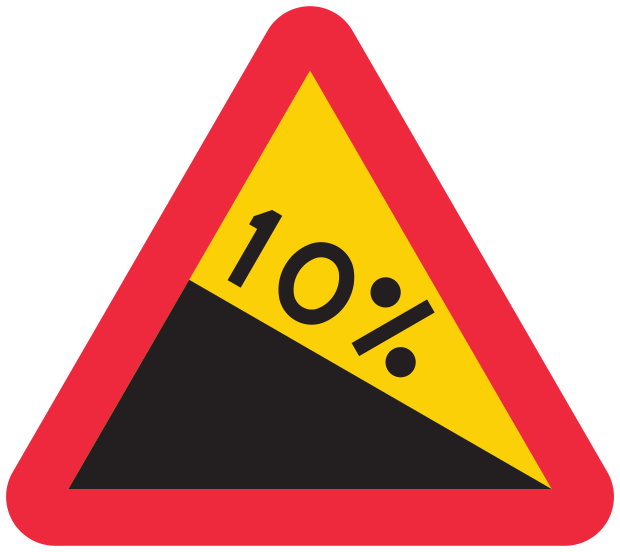
On a long, steep downhill slope you should therefore choose a lower gear and let the engine brake or retarder hold the speed. If you still need to use the service brake, it is better to brake firmly in bursts than to brake lightly all the time, so that the brakes have time to cool. You will then have full braking effect left if you need to stop quickly.
A retarder loses effect as speed falls and normally cannot bring the vehicle to a complete stop. The last part of a braking manoeuvre is done with the service brake. On a very slippery road you should be careful with a powerful retarder, because it only brakes the driving wheels.
Safety systems
The EU General Safety Regulation ((EU) 2019/2144) requires new buses and heavy lorries to have several advanced systems (Article 9):
- Lane departure warning system.
- Advanced emergency braking system (AEBS), which can detect a possible collision and apply the brakes automatically.
- Systems that detect pedestrians and cyclists in front of the vehicle or on the nearside and warn the driver.
- The vehicles must be designed so that blind spots in front of and to the side of the driver are reduced.
All new motor vehicles must also have, among other things, intelligent speed assistance and a system that warns of driver drowsiness (Article 6). The drowsiness warning assesses your attention by analysing signals from the vehicle. The systems are an aid, but they never replace your own attention or the rules on breaks and rest.
Load and passengers
Rational driving is also about what you are carrying.
Goods: The load must be secured so that it withstands 0.8 times its weight forwards and 0.5 times backwards and sideways (TSFS 2017:25 7 §). A well-placed and well-secured load makes the vehicle more stable and easier to drive. Place the centre of gravity low and close to the centre line, and think about how the load is distributed between the axles.
Passengers: Smooth acceleration and braking and good positioning on the road are central to the passengers' comfort and safety (direktiv 2022/2561 bilaga I, punkt 1.6). Standing passengers are particularly exposed to jerks and lateral forces.
Remember
- A diesel engine is most efficient at low revs and high load. Change up early.
- Drive with anticipation, coast when you can and avoid idling.
- Speed and air resistance have a big effect on consumption. The correct tyre pressure saves fuel.
- Use the engine brake or retarder on long downhill slopes so that the service brake does not overheat.
- The retarder cannot stop the vehicle completely.
- New heavy vehicles have lane departure warning, emergency braking systems and systems that detect pedestrians and cyclists.
- The safety systems are an aid, not a replacement for your attention.