Chapter 3 · Traffic rules · 5 min
Speed and traffic rules for heavy vehicles
As a lorry driver, the same basic traffic rules apply to you as to everyone else. But a heavy lorry has its own speed limits, and some rules and road signs are written specifically for heavy vehicles. In addition, the size of the vehicle means you have to think differently when turning, overtaking and keeping your distance.
New speed rules from 1 December 2026
On 1 December 2026 the Traffic Ordinance (trafikförordningen) gets a new 4 kap. 20 § (SFS 2026:1052). It sets the maximum permitted speed for different vehicles and vehicle combinations. For a heavy lorry (tung lastbil) the following apply:
- Heavy lorry without a trailer on a motorway (motorväg) or semi-motorway (motortrafikled): no more than 90 km/h.
- Heavy lorry without a trailer on other roads: no more than 80 km/h.
- Motor vehicle with a trailer that has effective brakes operated from the service brake (färdbromsen): no more than 80 km/h.
A vehicle combination where the lorry tows a dolly and a semi-trailer with anti-lock brakes may also be driven at no more than 80 km/h. For vehicle combinations of up to 34.5 metres under 4 kap. 17 f §, 80 km/h applies on the roads designated for such combinations (4 kap. 20 a §). Other combinations can have lower limits: 50, 40 or 30 km/h depending on the trailer and brakes.
The vehicle's limit is a ceiling
The vehicle's speed limit is always a ceiling, never a right to drive faster than the road allows. If the road is signed with a lower speed, that applies. If, on the other hand, the road is signed with a higher speed than your vehicle limit, it is your vehicle limit that applies.
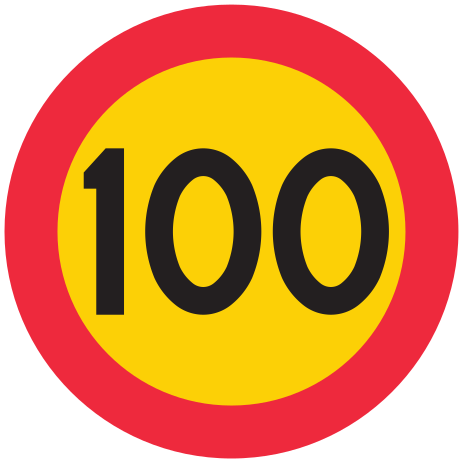
An example: you are driving a heavy lorry without a trailer on an ordinary rural road signed 100 km/h. You may still drive at no more than 80 km/h, because the road is neither a motorway nor a semi-motorway. If you drive the same lorry on a motorway signed 110 km/h, you may drive at no more than 90 km/h. If you have a heavy trailer with effective brakes, the limit is 80 km/h even on the motorway.
Road signs for heavy vehicles
Several prohibitory signs are especially important for lorry drivers:
- Limited vehicle height (C17), width (C16) and length (C18). The value on the sign applies to the vehicle with its load, and the length sign also applies to vehicle combinations.
- Limited gross weight (C20, for vehicles and vehicle combinations C21) and limited axle load (C23). These apply to the vehicle's actual weight and to each axle respectively.
- Bearing capacity class (C22). Shows the road's bearing capacity class (bärighetsklass), which governs the permitted axle loads, bogie loads and gross weights.
- No overtaking by heavy lorries (C29). You may not overtake motor-driven vehicles other than two-wheeled mopeds and two-wheeled motorcycles without a sidecar.
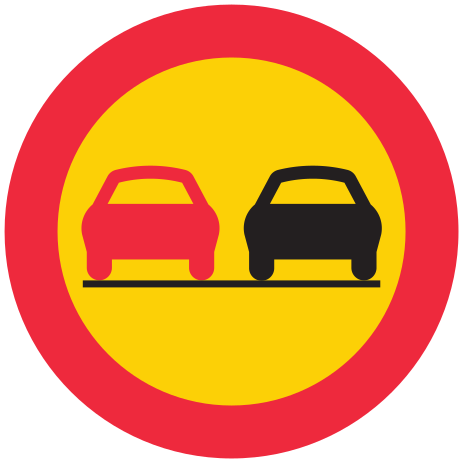
Note the difference. The ordinary no-overtaking sign applies to all drivers, while C29 only applies to heavy lorries. Where C29 is posted, cars may overtake, but you may not.
Distance to the vehicle in front
The Traffic Ordinance says that the distance to the vehicle in front must be large enough for you not to hit it if it brakes. The distance must also be adjusted so that other road users can easily overtake (3 kap. 2 §). This is especially important for heavy vehicles. Two lorries driving close behind each other form a long wall that is difficult and dangerous to overtake. Leave a gap that an overtaking car can pull into.
A heavy lorry also needs a longer braking distance than a car, especially when it is fully loaded. A longer distance gives you more time to react.
Turning and road position
A long lorry needs a lot of space at a junction. The rear wheels do not follow the track of the front wheels but cut in towards the inside of the bend.
Before a right turn you must, as a main rule, position yourself in the lane furthest to the right. If the space at the junction is not enough for your vehicle, you may depart from that position, but only with special care (3 kap. 25–26 §§). Pay particular attention to the traffic behind you when you turn. Both cyclists and moped riders can get in on your right-hand side while you wait.

Cyclists on a cycle path (cykelbana) have priority over other vehicles (3 kap. 59 §). So when you turn right across a cycle path, you must give way to the cyclist. The lorry's right-hand side has large blind spots. Check your mirrors carefully, preferably several times, before and during the turn.
Mobile phone
You may only use a mobile phone or other communication equipment while driving if it does not affect your driving negatively. You may never hold the phone in your hand (4 kap. 10 e §). Use hands-free or stop at a suitable place.
Why heavy vehicles demand extra responsibility
According to Trafikverket (the Swedish Transport Administration), lorries account for about six per cent of traffic volume but are involved in roughly one in five fatal crashes. In over 90 per cent of cases it is the other party who dies, usually someone in a car. This is because of the vehicle's mass. A small mistake with a lorry can have very serious consequences for others.
That does not mean lorry drivers drive worse than others. It means the margins must be larger. Plan your driving, keep to the speed limits and give other road users space.
Remember
- From 1 December 2026: heavy lorries 90 km/h on motorways and semi-motorways, 80 km/h on other roads.
- With a trailer that has effective brakes operated from the service brake, a maximum of 80 km/h applies, even on the motorway.
- A lower signed speed always takes precedence over the vehicle limit.
- C29 prohibits you from overtaking motor-driven vehicles other than two-wheeled mopeds and two-wheeled motorcycles without a sidecar.
- Keep a distance that makes it easy for others to overtake you.
- When turning right you may depart from the right-hand lane if there is not enough space, but with special care.
- Cyclists on a cycle path have priority. Check your mirrors carefully.
- You may never hold your mobile phone in your hand while driving.