Chapter 6 · Traffic rules · 7 min
Overtaking and meeting oncoming traffic
Overtaking (omkörning) is one of the most dangerous manoeuvres in traffic, because for a while you are driving in the oncoming lane. Meeting oncoming traffic (möte) on narrow roads also requires planning. This chapter goes through the rules and how you judge whether an overtaking manoeuvre is really worth the risk.
Meeting oncoming traffic
When meeting oncoming traffic you must keep to the right and leave a safe sideways distance to the oncoming vehicle (Traffic Ordinance (trafikförordningen) 3 kap. 30 §). On narrow roads this often means you need to slow down considerably.
Obstacles on the road
If there is an obstacle, for example a parked car, it is the driver who has the obstacle on their side who must stop if necessary so that the oncoming driver can pass (trafikförordningen 3 kap. 30 §). So if the car is on your side of the road, it is you who must wait.
Passing places and narrow stretches
On some narrow stretches, for example narrow bridges, road signs decide who must wait.
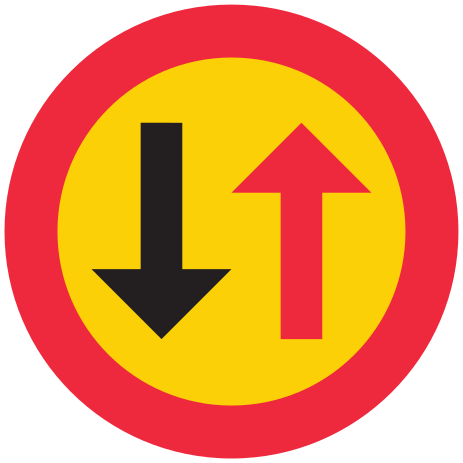
Give way to oncoming traffic (väjningsplikt mot mötande trafik): you may not drive onto the stretch if you would then obstruct oncoming traffic.
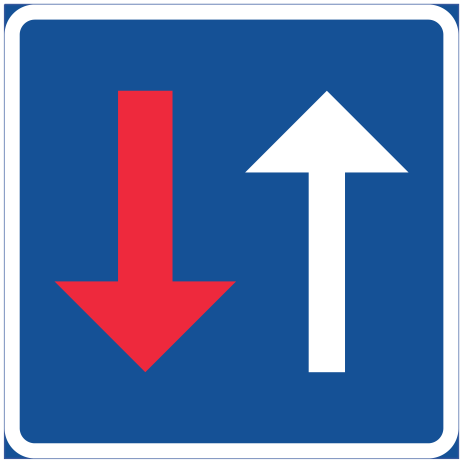
Oncoming traffic must give way (mötande trafik har väjningsplikt): you have priority, but be prepared in case the oncoming driver does not wait.
Trains and trams
When meeting a train or tram on the road, you must keep to the right (trafikförordningen 3 kap. 34 §). A train or tram on the road is overtaken on the right (trafikförordningen 3 kap. 35 §). Where the position of the tracks requires it, you may keep to the left or overtake on the left, if this can be done without danger or inconvenience. On a one-way carriageway you may also overtake on the left.
Overtaking – the basic rules
As a main rule, overtaking takes place on the left (trafikförordningen 3 kap. 31 §). You must overtake on the right when the driver in front is turning left or is clearly preparing to turn left, for example has indicated and moved towards the middle.
Cyclists and moped riders may overtake vehicles other than bicycles and mopeds on the right (trafikförordningen 3 kap. 31 §). Expect that a cyclist may come up along your right-hand side in a queue.
When may you overtake?
You may only overtake if it can be done without danger (trafikförordningen 3 kap. 32 §). In addition:
- the lane you are going to use must be free of oncoming traffic over a sufficiently long distance (trafikförordningen 3 kap. 36 §),
- you must be able to move back to the right without danger to the vehicle you are overtaking (trafikförordningen 3 kap. 36 §),
- nobody behind you has already started to overtake you (trafikförordningen 3 kap. 32 §),
- the driver in front has not signalled an intention to overtake or turn left themselves (trafikförordningen 3 kap. 32 §).
You must leave a safe sideways distance (betryggande avstånd i sidled) to the vehicle you are overtaking (trafikförordningen 3 kap. 33 §). This applies especially when you overtake cyclists and moped riders, who may wobble or swerve to avoid holes in the road.
When the overtaking is complete, you must keep to the right again as soon as it can be done without danger or inconvenience (trafikförordningen 3 kap. 37 §).
Where overtaking is prohibited
Even if you do not see a prohibitory sign, overtaking is prohibited in several places.
- Immediately before or at a road junction. There are certain exceptions, for example when the junction is controlled (trafikförordningen 3 kap. 39 §). Still assume that junctions are the wrong place to overtake.
- Immediately before or at a level crossing with a railway or tramway, if the crossing has no barriers or traffic signals (trafikförordningen 3 kap. 39 §).
- At the crest of a hill and on bends with obstructed visibility, unless special conditions are met (trafikförordningen 3 kap. 39 §).
- Immediately before or at an uncontrolled pedestrian crossing (obevakat övergångsställe), an uncontrolled cycle passage (cykelpassage) or a cycle crossing (cykelöverfart) (trafikförordningen 3 kap. 40 §).
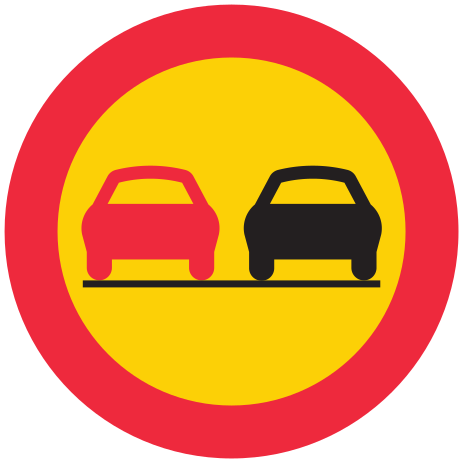
Overtaking can also be prohibited by a road sign. Even where it is permitted, a solid line can prevent you from moving out into the oncoming lane.
Passing before a pedestrian crossing
In some cases it does not count as overtaking when you pass vehicles in another lane, for example when there is a dense queue in all lanes or when the vehicles have positioned themselves in different lanes before a junction. If you then pass another vehicle before a pedestrian crossing, you must keep your speed so low that you can stop immediately if a pedestrian is on the crossing. The same applies to cyclists and class II moped riders on a cycle passage or cycle crossing (trafikförordningen 3 kap. 41 §). The car next to you may have stopped precisely because it is letting someone cross whom you cannot see. In other cases it is overtaking, and it is prohibited immediately before an uncontrolled pedestrian crossing (trafikförordningen 3 kap. 40 §).
When someone overtakes you
The driver being overtaken also has obligations. If you notice that someone wants to overtake you on the left, you must keep as far to the right as necessary. You may not increase your speed or make the overtaking more difficult in any other way (trafikförordningen 3 kap. 38 §). If the overtaking looks as though it is going wrong, it is often safest to slow down a little so that the other driver gets past quickly.
Is the overtaking worth it?
Overtaking takes longer and requires a longer distance than many people think. Your speed must be adapted to what road safety requires during the overtaking too (trafikförordningen 3 kap. 14 §). Ask yourself a few questions before you pull out:
- Can I see far enough ahead? An oncoming vehicle at 90 km/h approaches you just as fast as you are driving forward.
- Am I overtaking several vehicles? Then I need to be able to pull in between them if something happens.
- Do I gain anything? On an ordinary journey you rarely save more than a minute or so.
- Are there exits, farm entrances or junctions where someone could pull out or turn?
If you are the slightest bit unsure: don't. Wait for a stretch with a central barrier (mötesfri sträcka) or a straight stretch with good visibility.
Buses pulling out from a stop
Where the maximum permitted speed is 50 km/h or lower, you must slow down and let a bus that is indicating to pull out from a stop leave the stop. Stop if necessary (trafikförordningen 3 kap. 45 §). At the same time, the bus driver must be careful and not cause danger.
You must also keep a sufficiently low speed when approaching a bus, tram or school transport (skolskjuts) that has stopped to let passengers on or off (trafikförordningen 3 kap. 15 §). Children may run out in front of the bus.
Remember
- When meeting oncoming traffic, keep to the right. The driver who has the obstacle on their side must wait.
- Overtaking takes place on the left, but on the right if the driver in front is clearly going to turn left.
- Only overtake when the oncoming lane is clear far enough ahead and you can safely move back in.
- No overtaking immediately before or at junctions, level crossings without barriers or signals, at blind crests and bends or at uncontrolled pedestrian crossings.
- The driver being overtaken may not increase their speed.
- At 50 km/h or lower, you must give the bus the chance to leave the stop.