Chapter 8 · Traffic rules · 6 min
Stopping and parking
Many of the rules on stopping and parking are not shown on any sign. They still apply, and you are expected to know them. The basic idea is simple: a stationary car must not create danger, block visibility or obstruct others unnecessarily.
Stopping or parking?
There is a difference between stopping (stanna) and parking (parkera), and some prohibitions only apply to one of them.
- Stopping (stanna) means keeping the vehicle stationary, except when you do so to avoid danger or because the traffic requires it, for example in a queue or at a red light.
- Parking (parkera) means leaving the vehicle standing, with or without a driver, for reasons other than letting someone get in or out or loading or unloading goods.
Quickly dropping off a passenger or unloading a heavy box therefore counts as stopping. Waiting in the car for someone who is shopping counts as parking, even if you stay behind the wheel.
Basic rules
- A vehicle must not be stopped or parked so that it creates danger or unnecessarily obstructs or disrupts traffic (Traffic Ordinance (trafikförordningen) 3 kap. 47 §).
- Nor may it stand so that it hides road signs or signals (trafikförordningen 3 kap. 47 §).
- You may only stop and park on the right-hand side in the direction of travel. On roads with one-way traffic you may also stop and park on the left-hand side (trafikförordningen 3 kap. 52 §).
- Outside a built-up area (tättbebyggt område) you must stop or park off the carriageway if possible.
Here you may neither stop nor park
The following applies without needing to be signed (trafikförordningen 3 kap. 47 och 53 §§):
- on a railway or tramway level crossing,
- on a pedestrian crossing (övergångsställe) or within 10 metres before it, and the same for a cycle passage (cykelpassage) and cycle crossing (cykelöverfart),
- in a road junction or within 10 metres of the nearest outer edge of the crossing carriageway,
- within 10 metres before a crossing cycle track or footpath,
- on or near the crest of a hill or on a bend where visibility is obstructed,
- alongside a solid line between lanes if the distance between the car and the line is less than 3 metres, unless there is a broken line between the car and the solid line,
- in a cycle lane (cykelfält),
- in an underpass or tunnel, in a hatched area (spärrområde) and in a roundabout (cirkulationsplats),
- in a lane or carriageway for vehicles in regular public transport service (linjetrafik).
Nor may you stop or park on a footpath or cycle track (trafikförordningen 3 kap. 48 §).
Bus stop
You may not park at a stop for a bus, tram or school transport. Nor may you stop there, except to let someone get in or out, and only if this is done without obstructing the bus, tram or school transport. If the stop is not marked on the road, the prohibition applies 20 metres before and 5 metres after the bus stop sign (trafikförordningen 3 kap. 54 §). Note that the prohibition starts well before the sign.
Here you may stop but not park
Parking is prohibited at the following places, but you may stop there, for example to let someone out (trafikförordningen 3 kap. 55 §):
- within 30 metres of a level crossing with a railway or tramway,
- in front of the entrance to a property, or so that it becomes difficult to get in or out,
- on a priority road (huvudled),
- on the carriageway next to another vehicle that is already standing at the roadside (double parking).

Time limit: 24 hours
Unless otherwise signed, a car may be parked in the same place for at most 24 consecutive hours on weekdays, except a weekday before a Sunday or public holiday (trafikförordningen 3 kap. 49 a §). The rule applies on the municipality's streets and other public places within built-up areas and on public roads. After that the car must be moved.
Parking signs

No parking (förbud mot parkering) means that you may stop, for example to drop someone off, but not park.
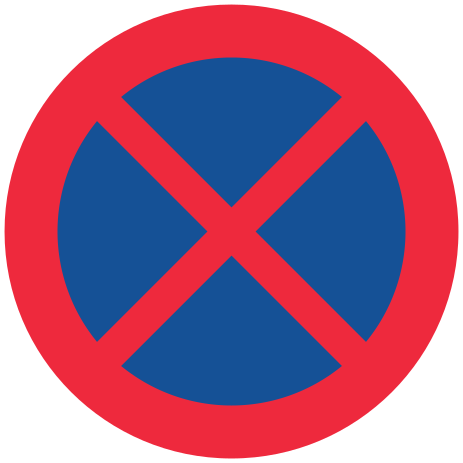
No stopping or parking (förbud mot att stanna och parkera) means that you may not be stationary at all, except when the traffic forces you to.
Both prohibitions apply from the sign up to the next junction, and only on the side of the road where the sign stands (Road Signs Ordinance (vägmärkesförordningen) 2 kap. 8 §). Without an additional panel, the prohibition applies around the clock.
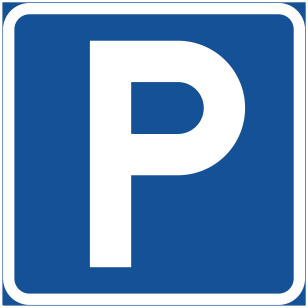
Parking (parkering) shows where you may park. Under the sign there are often additional panels (tilläggstavlor) that tell you:
- when the parking applies (time indication),
- how long you may stay (for example "2 tim", 2 hours),
- whether there is a charge (avgift),
- which vehicles the space is for (symbol panel).
Read the sign from top to bottom
Read the additional panels one at a time. Check the day and time. Figures without brackets apply on weekdays, figures in brackets apply on the day before a Sunday or public holiday, and red figures apply on Sundays and public holidays (vägmärkesförordningen 2 kap. 30 §). If you are unsure, it is better to find another space than to take a chance.
When the car stops involuntarily
If, because of an accident, an engine fault or similar, the car comes to a stop where stopping is prohibited, you must move it as soon as possible to a suitable place (trafikförordningen 3 kap. 51 §).
If the car is on the carriageway or the hard shoulder where the speed limit is higher than 50 km/h and where stopping is not permitted, you must put out the warning triangle (varningstriangel) (trafikförordningen 3 kap. 57 §). This also applies if you are on the carriageway and the weather or other circumstances make it difficult for others to see the car in time. There is more about this in the chapter on darkness, slippery roads and accidents.
Parking safely
Some good habits:
- Look back before you open the door towards the traffic. A cyclist can come quickly.
- Let passengers get out on the pavement side.
- In darkness, dusk and dawn, the parking lights and rear lights must be on if the car is standing on the road, unless the road is so well lit that the car can be clearly seen (trafikförordningen 3 kap. 74 och 75 §§).
- Apply the parking brake and turn the wheels towards the kerb on a steep hill.
Remember
- Stopping to let people out and in or to load is stopping, not parking.
- Stop and park on the right-hand side; on a one-way road also on the left.
- No stopping or parking on the pedestrian crossing, 10 metres before it, in the junction or within 10 metres of it.
- Bus stop without markings: you may not park from 20 metres before to 5 metres after the sign, and may only stop to let people off and on without obstructing the bus.
- No parking on a priority road, in front of entrances or within 30 metres of a level crossing.
- Parking prohibition signs apply up to the next junction and only on the same side as the sign.