Chapter 3 · Traffic rules · 6 min
Road signs
Road signs (vägmärken) tell you what applies at the exact place where you are driving. They can warn, prohibit, require or give information. You do not need to know every sign by heart to understand them. If you know which group a sign belongs to, you already know roughly what it is telling you.
Signs take precedence over the traffic rules
An instruction given by a road sign, road marking or traffic signal applies before the general traffic rules when they say different things (Traffic Ordinance (trafikförordningen) 2 kap. 2 §). An example: the right-hand rule applies at a junction, but if there is a give way sign, it is the sign that decides.
A police officer's instruction in turn takes precedence over both the traffic rules and the road signs (trafikförordningen 2 kap. 3 §).
The groups
Road signs are divided into groups with letters (Road Signs Ordinance (vägmärkesförordningen) 2 kap. 1 §). The most important ones for you as a car driver are:
| Group | Name | What they do |
|---|---|---|
| A | Warning signs (varningsmärken) | Warn of a hazard further ahead |
| B | Priority signs (väjningspliktsmärken) | Show who has priority |
| C | Prohibitory signs (förbudsmärken) | Tell you what you may not do |
| D | Mandatory signs (påbudsmärken) | Tell you what you must do |
| E | Information signs (anvisningsmärken) | Give information about what applies at the place |
| F–I | Direction and location signs (lokaliseringsmärken) | Route guidance and information about places and services |
| J | General information signs (upplysningsmärken) | Other information |
In addition to the signs there are additional panels (tilläggstavlor), which are placed below a sign and supplement it.
Warning signs (A)
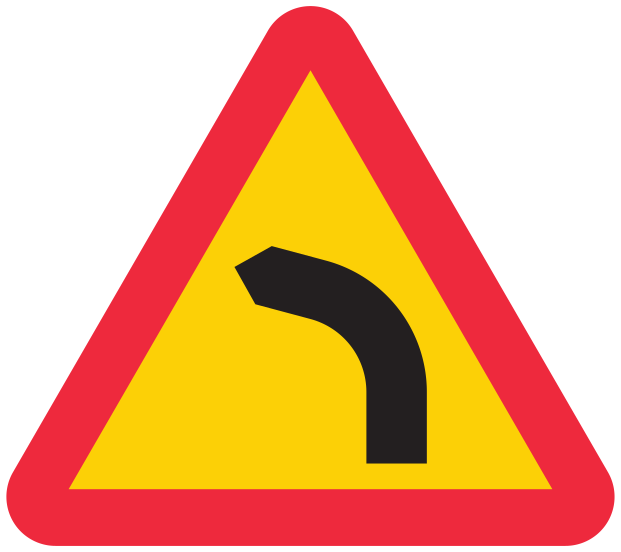
Warning signs warn of a hazard and tell you what kind of hazard it is (vägmärkesförordningen 2 kap. 4 §). They are triangular with the point upwards. The sign is placed at the distance from the hazard where it is most useful, so that you have time to adjust your speed.
Examples of warning signs:
- bends, steep hills and road narrowing,
- pedestrian crossing, traffic signal and speed bump,
- junction and roundabout,
- level crossing,
- other danger, with an additional panel explaining what it is about.
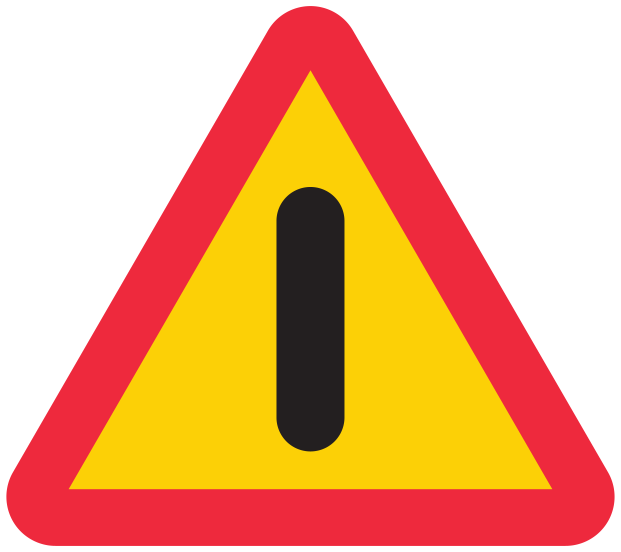
A warning sign is not an order, but it is a clear signal to slow down and be prepared. If you drive past a warning sign too fast and then cannot make it round the bend, you have broken the requirement to adapt your speed (trafikförordningen 3 kap. 14 §).
Priority signs (B)
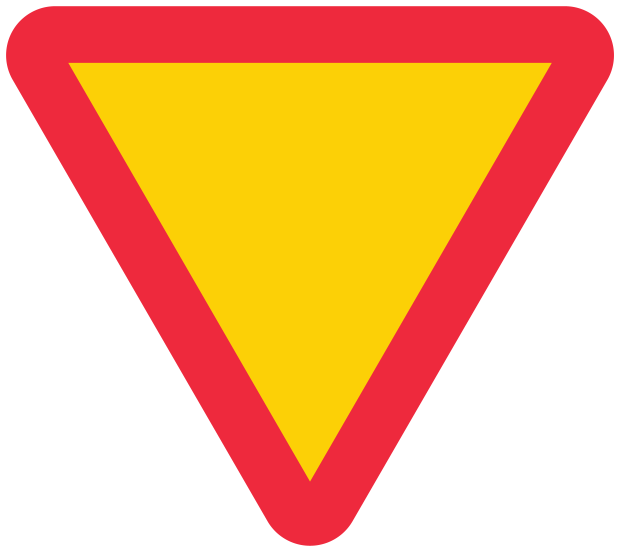
The priority signs show who must let whom go first. This group includes give way (väjningsplikt), stop (stopplikt), priority road (huvudled) and end of priority road (huvudled upphör). We go through them in the chapter on the duty to give way and junctions.
Two signs in the group apply to meeting oncoming traffic at narrow places, for example a narrow bridge or a road narrowing:
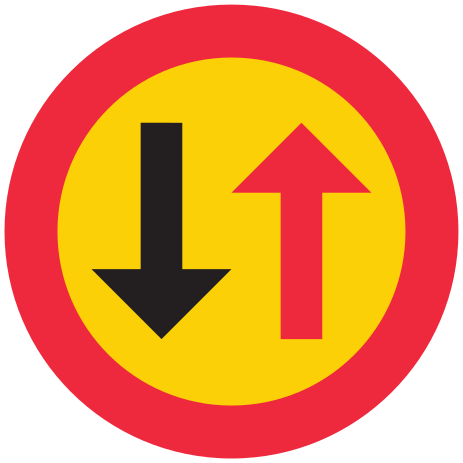
Give way to oncoming traffic (väjningsplikt mot mötande trafik): you may not drive onto the stretch if you would obstruct an oncoming vehicle. Let the oncoming driver go first.
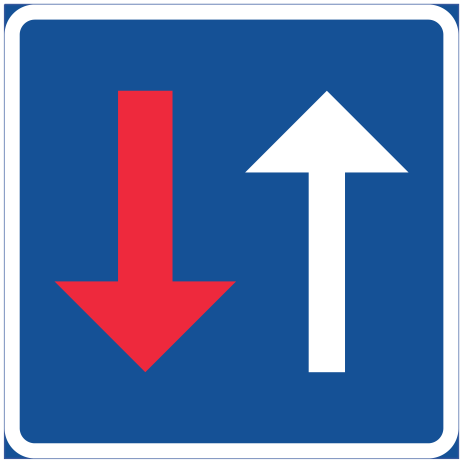
Oncoming traffic must give way (mötande trafik har väjningsplikt): you have priority, and the oncoming driver must wait. Still be prepared to stop if the other driver does not.
Prohibitory signs (C)
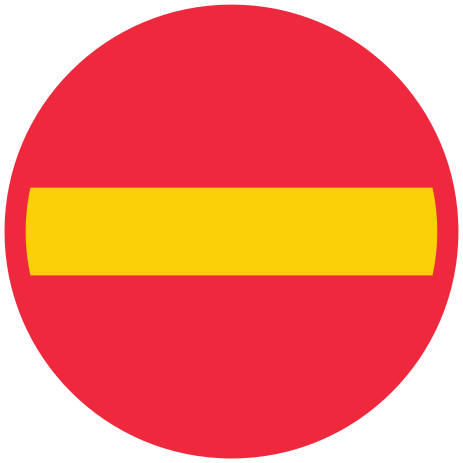
Prohibitory signs are usually round with a red border. They tell you what is prohibited, for example:
- no entry for vehicles (förbud mot infart med fordon),
- no traffic with vehicles (förbud mot trafik med fordon),
- no overtaking (förbud mot omkörning),
- no left or right turn, or no U-turn,
- restricted height, width, length or weight,
- maximum permitted speed.
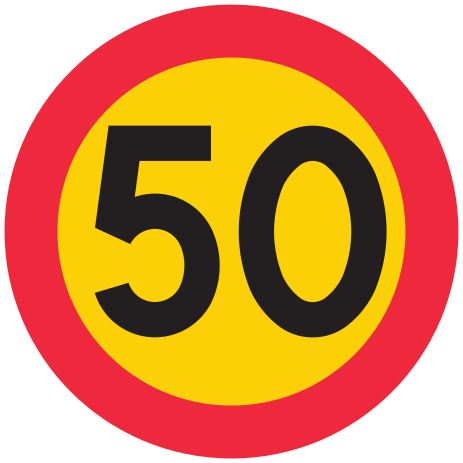
A speed limit (hastighetsbegränsning) applies until a new sign states a different speed (vägmärkesförordningen 2 kap. 8 §). The sign does not need to be repeated after every junction.
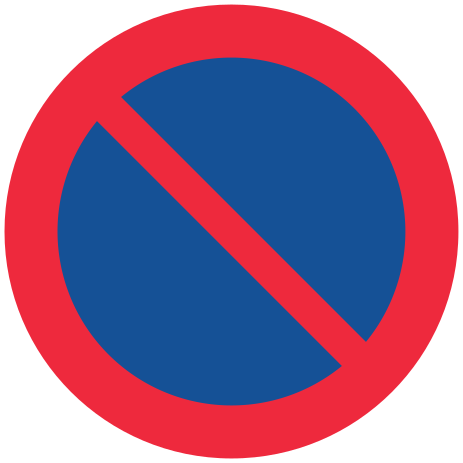
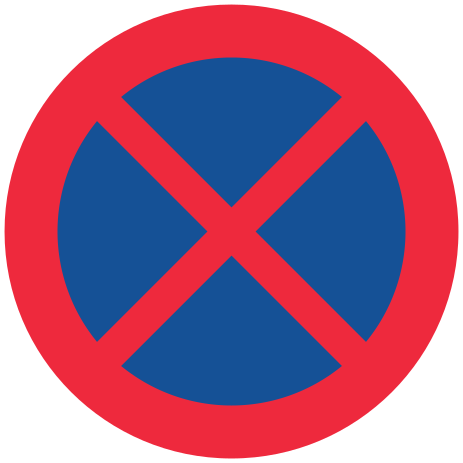
A prohibition on parking or on stopping and parking applies from the sign up to the next junction, and only on the side of the road where the sign stands (vägmärkesförordningen 2 kap. 8 §). The prohibition can also end earlier at a sign with an additional panel with an arrow pointing downwards.
Mandatory signs (D)
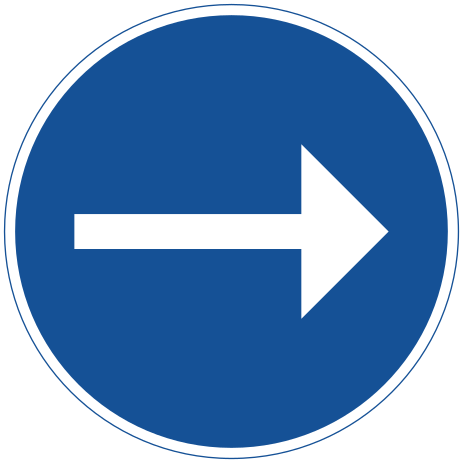
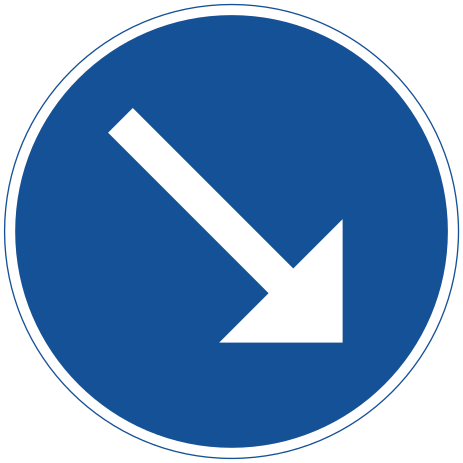
Mandatory signs are round and blue. They tell you what you must do, for example drive in a certain direction or pass an obstacle on a certain side. The sign for mandatory direction in a roundabout shows that traffic must drive anticlockwise around the roundabout.
Information signs (E)
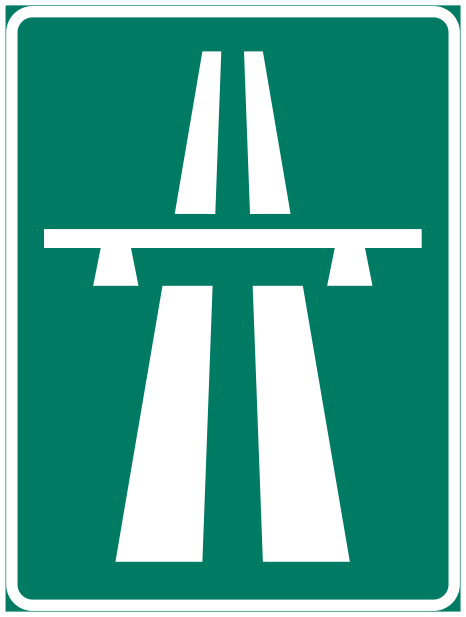
Information signs tell you what applies at a place or on a road. They often come with rules that you have to know yourself, because they are not written on the sign. Examples:
- Motorway (motorväg) and expressway (motortrafikled): special rules apply; see the chapter on motorways.
- One-way street (enkelriktat): all traffic drives in the same direction.
- Dead end (återvändsgata): the street ends and you cannot drive through.
- Pedestrian crossing (övergångsställe): the sign shows where the pedestrian crossing is.
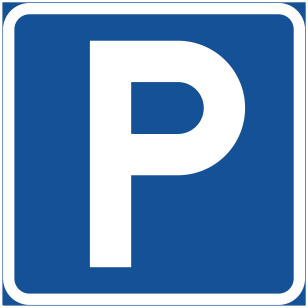
- Parking (parkering): you may park here, often with additional panels about time and fees.
Additional panels
An additional panel (tilläggstavla) gives a supplementary instruction to the sign above it (vägmärkesförordningen 2 kap. 29 §). If there are several panels under a sign, each of them applies. Some common panels:
- Distance (avstånd) states how far it is to where the sign applies, for example to the hazard further ahead.
- Extent (utsträckning) states the length of the stretch over which the sign applies.
- Symbol panel (symboltavla) restricts the sign to a certain type of vehicle or a certain group of road users.
- Time indication (tidsangivelse) states when the sign applies.
Reading time indications
Time indications follow a fixed system (vägmärkesförordningen 2 kap. 30 §):
- Figures without brackets apply on weekdays, except a weekday before a Sunday or public holiday.
- Figures in brackets apply on a weekday before a Sunday or public holiday, for example an ordinary Saturday.
- Red figures apply on Sundays and public holidays.
Example: "8–18 (8–14)" under a parking prohibition means that the prohibition applies Monday–Friday 8–18 and Saturday 8–14. On Sundays it does not apply at all, because there are no red figures. If there is no time indication, a prohibitory sign applies around the clock.
Yellow road markings
Road markings are white unless otherwise stated (vägmärkesförordningen 4 kap. 3 §). There are two kinds of yellow markings:
- Temporary yellow markings, for example at roadworks. They apply instead of the usual white markings for as long as they are there (vägmärkesförordningen 4 kap. 3 §).
- No stopping and no parking at the edge of the carriageway. A solid yellow line (M21) means no stopping or parking, and a broken yellow line (M22) means no parking. M22 is also used to show how far a bus stop extends. There is more about them in the chapter on road markings.
Remember
- Road signs take precedence over the traffic rules, and police instructions take precedence over road signs.
- Warning signs warn of a hazard further ahead. Slow down and be prepared.
- A speed limit applies until a new speed sign appears.
- A prohibition on parking or stopping applies up to the next junction and only on the side where the sign stands.
- Time indications: without brackets weekdays, in brackets the day before a public holiday, red figures Sundays and public holidays.
- Additional panels supplement the sign above them, for example with distance, time or type of vehicle.