Chapter 2 · Traffic rules · 7 min
Duty to give way and junctions
At a junction, traffic meets from several directions, so everyone needs to know who must let whom go first. The rules on the duty to give way (väjningsplikt) answer that question. This chapter goes through the basic rule, the exceptions and how you show that you are giving way.
What does duty to give way mean?
Having a duty to give way (väjningsplikt) means that you must let the other road user pass first. You must clearly show that you intend to give way by reducing your speed or stopping in good time. You may continue only when it can be done without danger or obstruction, taking into account the others' position, distance and speed (Traffic Ordinance (trafikförordningen) 3 kap. 5 §).
Showing that you are giving way in good time is important. If you arrive at high speed and brake hard at the last moment, the other driver does not know whether you intend to stop, and that creates uncertainty.
The right-hand rule
The basic rule is simple: when the paths of two vehicles cross, the driver has a duty to give way to the vehicle coming from the right (trafikförordningen 3 kap. 18 §). This right-hand rule (högerregeln) applies when nothing else has been decided, that is, when there are no road signs, traffic signals or special rules that say otherwise.
The right-hand rule applies at all junctions without signs, both in town and in the countryside. It is common in residential areas. Be particularly alert there: a car may come from a small side street on your right, and that driver has priority.
Also bear in mind that an instruction from a road sign or signal takes precedence over the traffic rules (trafikförordningen 2 kap. 2 §). The right-hand rule therefore only applies when nothing else has been decided.
The give way sign and the duty to stop
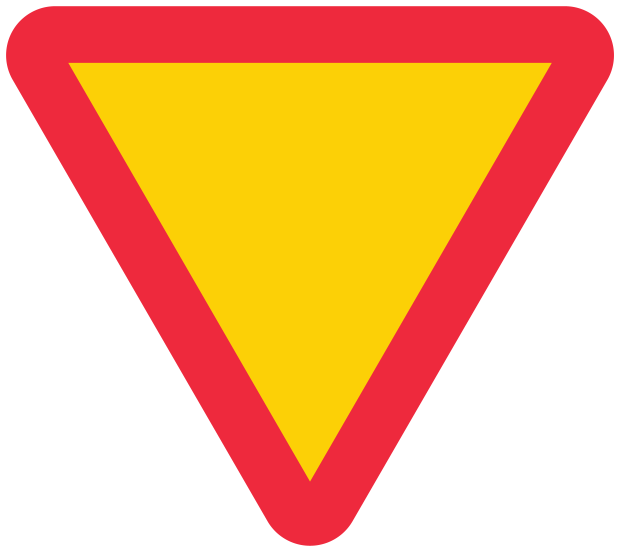
The give way sign (väjningsplikt) means that you must give way to traffic on the crossing road, regardless of whether it comes from the right or the left. You do not need to stop if the road is clear, but you must slow down so clearly that others understand you are giving way.
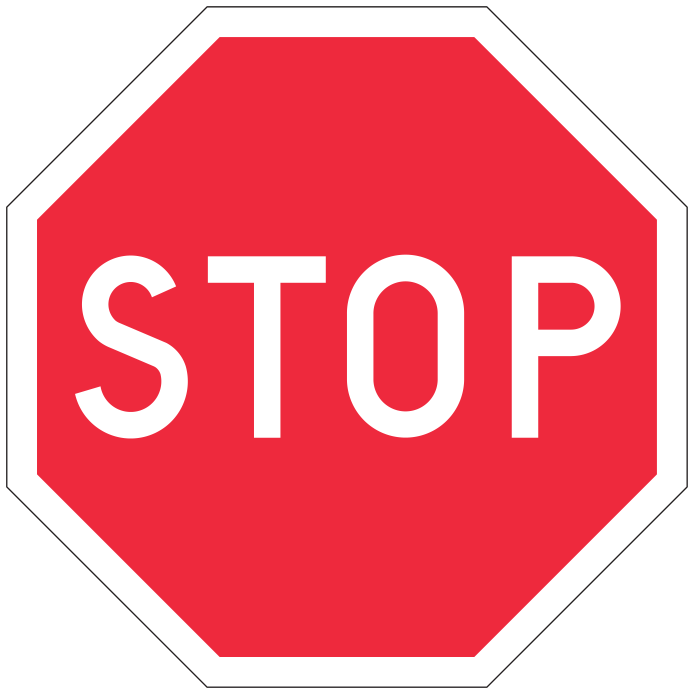
The duty to stop (stopplikt) is a duty to give way with an extra requirement: you must always stop completely, even if the road is clear. You must stop at the stop line. If there is no stop line, you stop immediately before you drive onto the crossing road (trafikförordningen 3 kap. 19 §). After stopping, you have a duty to give way just as at the give way sign.
The duty to stop is used where visibility is poor or where the junction is particularly dangerous for some other reason.
Priority road

A priority road (huvudled) is a road where traffic has priority over traffic from connecting roads. Anyone who drives onto a priority road from another road where there is no acceleration lane has a duty to give way to traffic on the priority road (trafikförordningen 3 kap. 21 §). The same rule applies when you drive onto a motorway (motorväg) or an expressway (motortrafikled) without an acceleration lane. The duty to give way does not apply if you join the road without needing to change lanes.
So if you are driving on the priority road, you have priority at the junctions. That does not mean you can stop paying attention. Sometimes someone fails to give way.
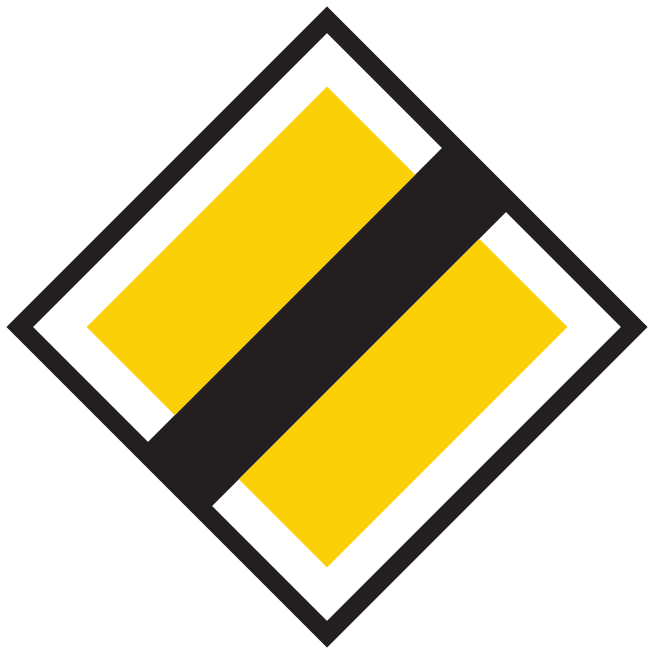
When the end of priority road sign (huvudled upphör) appears, the priority no longer applies. At the next junction the right-hand rule may apply, or there may be other signs.
Duty to give way when leaving an exit
A driver has a duty to give way to all vehicles whose path crosses their own when they drive out onto a road (trafikförordningen 3 kap. 21 §):
- from a car park, a property, a petrol station or a similar area,
- from a path, a private access track (ägoväg) or a similar exit road,
- from a cycle track, a pedestrian street (gågata), a pedestrian-priority zone (gångfartsområde), a cycle street (cykelgata) or from off-road terrain,
- after crossing a footpath or cycle track.
So the right-hand rule does not apply here. Someone driving out of a car park has a duty to give way even to traffic coming from the left. There is an exception for cyclists and riders of class II mopeds (moped klass II) crossing the carriageway at a cycle crossing (cykelöverfart).
Roundabout
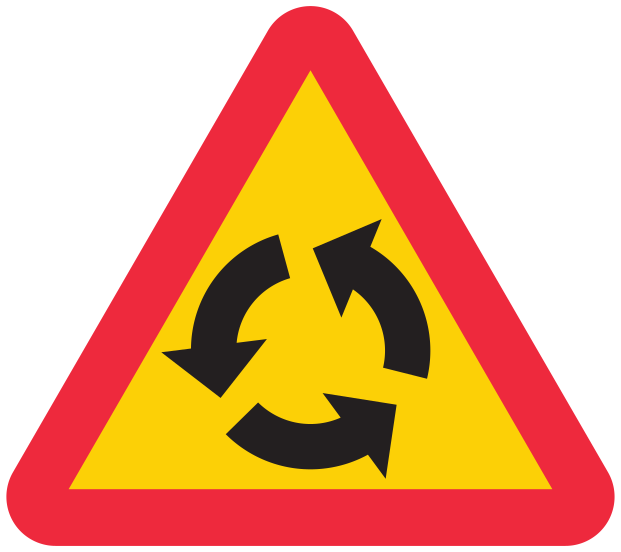
In a roundabout (cirkulationsplats), all traffic drives anticlockwise around the roundabout (trafikförordningen 3 kap. 13 §). Anyone entering the roundabout has a duty to give way to every vehicle already in the roundabout (trafikförordningen 3 kap. 22 §). This applies even if there is no give way sign at the entry.
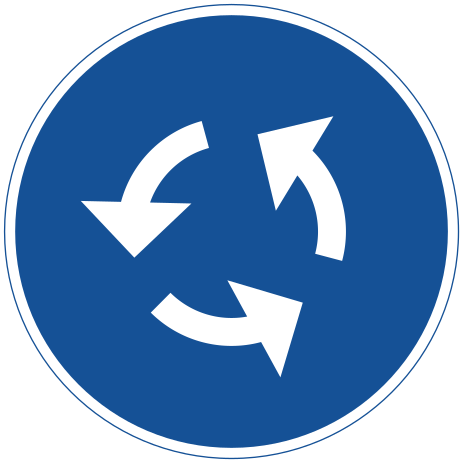
Some practical advice:
- Slow down in good time and look to the left; that is where traffic in the roundabout comes from.
- There is no requirement to indicate when you enter, but indicate with your direction indicator when you change lanes inside the roundabout.
- Always indicate right before you exit, so that those waiting at the next entry can see what you intend to do (trafikförordningen 3 kap. 65 §).
Turning at the junction
Anyone who is going to turn, leave or cross the carriageway must make sure that it can be done without obstructing oncoming traffic or traffic on the road they are entering (trafikförordningen 3 kap. 24 §). In practice this means that someone turning left must let oncoming traffic going straight ahead or turning right go first.
When you approach a junction you must also adapt your driving so that you do not end up standing still and blocking crossing traffic if you have to stop (trafikförordningen 3 kap. 20 §). Do not drive into the junction if you can see that the queue on the other side is not moving.
Emergency vehicles, trains and trams
Some road users always have priority, regardless of the right-hand rule or road signs:
- Emergency vehicles (utryckningsfordon) with sirens on must be given a clear path. Stop if necessary (trafikförordningen 2 kap. 5 §). Do this calmly and predictably, and do not move your car out into a junction against a red light if that creates danger.
- Trains and trams must also be given a clear path, unless the tram driver has a duty to give way shown by a road sign (trafikförordningen 2 kap. 5 §).
A way of thinking at junctions
Go through the same order every time you approach a junction:
- Is there a police officer or a traffic signal? Then that applies.
- Is there a give way sign, a duty to stop or a priority road? Then that applies.
- Am I driving out from a car park, property or similar? Then I give way to everyone.
- Otherwise the right-hand rule applies.
Remember
- Anyone who has a duty to give way must show it clearly and in good time by slowing down or stopping.
- The right-hand rule applies when nothing else has been decided: let vehicles from the right go first.
- With a duty to stop you must always stop completely, at the stop line if there is one.
- If you drive onto a priority road, you have a duty to give way to traffic on the priority road. If you drive out from a car park, property or cycle track, you have a duty to give way to everyone whose path you cross.
- In a roundabout, anyone entering has a duty to give way to traffic in the roundabout. Indicate right before you exit.
- Emergency vehicles with sirens and trains must always be given a clear path. This also applies to trams, unless a road sign gives the tram a duty to give way.