Chapter 2 · Vehicle knowledge and handling · 6 min
Dimensions, weights and bearing capacity classes
A lorry driver must be able to do the maths. Roads and bridges can only take a certain load, and a vehicle that is too wide or too long can become dangerous to others. The rules on dimensions and weights are in the fourth chapter of the Traffic Ordinance (trafikförordningen). Here we go through the most important terms and limits.
Weight terms you must know
The Road Traffic Definitions Act (lagen om vägtrafikdefinitioner) (2 §) distinguishes between several different weights. Do not mix them up.
- Kerb weight (tjänstevikt): the vehicle in fully operational condition with fuel, water, tools, spare wheel and driver.
- Gross vehicle weight (totalvikt): the kerb weight plus the largest load and the largest number of people the vehicle is designed for. The gross vehicle weight is stated in the registration certificate and decides, for example, whether the lorry is heavy (over 3.5 tonnes).
- Gross weight (bruttovikt): what the vehicle actually weighs on the road surface at a given moment. An empty lorry has a low gross weight, even if its gross vehicle weight is high.
- Axle load (axeltryck): the weight that the wheels on one axle transfer to the road surface.
- Bogie load (boggitryck): the weight that the wheels in a bogie (boggi), that is two axles less than 2 metres apart, transfer to the road surface.
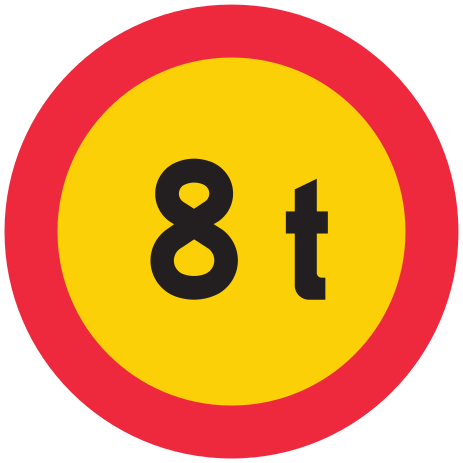
The difference between gross vehicle weight and gross weight matters a great deal for road signs. A sign showing a gross weight limit applies to what the vehicle weighs at that moment, not to what is stated in the registration certificate.
Width
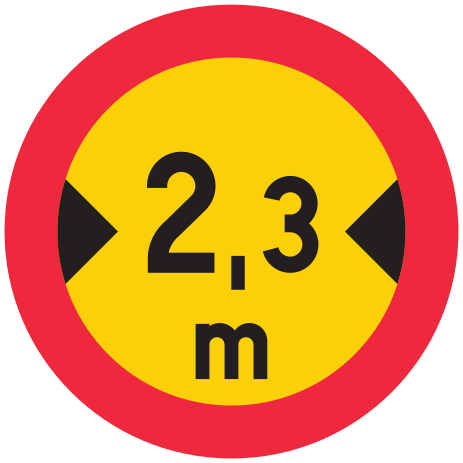
A vehicle may not be wider than 2.60 metres, including the load, if it is to be driven on roads other than private roads (enskilda vägar) (Traffic Ordinance (trafikförordningen) 4 kap. 15 §). The same applies if the load sticks out more than 20 centimetres beyond the side of the vehicle: as a main rule, the vehicle may then only be driven on a private road. If you need to carry out a wider transport, an exemption (dispens) from Trafikverket (the Swedish Transport Administration) is required.
Length
The main rule is that a vehicle or vehicle combination (fordonståg), including the load, may be no more than 24.0 metres long (4 kap. 17 §). However, a vehicle combination may be up to 25.25 metres if a number of conditions are met. Some of them are:
- each motor vehicle in the combination is no more than 12.0 metres long,
- each trailer except a semi-trailer (påhängsvagn) is no more than 12.0 metres,
- the width is no more than 2.55 metres, or 2.60 metres for temperature-controlled bodies, containers and swap bodies,
- the vehicles have anti-lock brakes and meet the turning requirements.
On roads that Trafikverket or the municipality has specifically designated, vehicle combinations may be up to 34.5 metres (4 kap. 17 f §). Outside those roads the ordinary length limits apply.
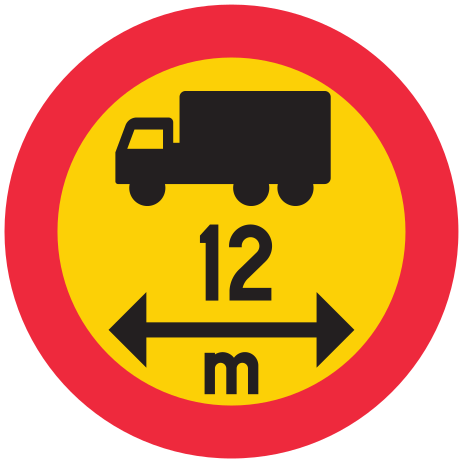
The length limit sign applies both to single vehicles and to vehicle combinations. It is the length of the whole combination that counts.
Height
The Traffic Ordinance has no general height limit for lorries. That does not mean you can ignore the height. You must know yourself how high your lorry is with its load, and you must respect the sign for limited vehicle height. The sign is put up where the clearance is less than 4.5 metres (Road Signs Ordinance (vägmärkesförordningen) C17).
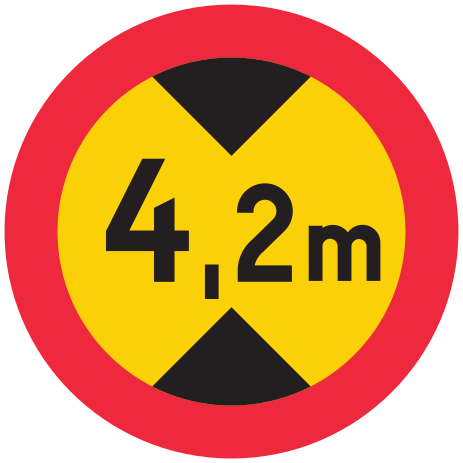
It is a good idea to write the lorry's height on a note in the cab, especially if you switch between different vehicles or carry high loads.
Bearing capacity classes
The road network is divided into bearing capacity classes (bärighetsklasser), which determine how heavy the vehicles driven there may be. A public road belongs to BK1 unless otherwise decided. Trafikverket, or the municipality if it is the road authority (väghållare), can decide that a road is to belong to BK2, BK3 or BK4.
The maximum permitted gross weight for a vehicle combination depends on the bearing capacity class and on the distance between the first and last axles:
| Bearing capacity class | Maximum gross weight |
|---|---|
| BK4 | 74 tonnes (from an axle distance of 20.2 metres) |
| BK1 | 64 tonnes (from an axle distance of 20.2 metres) |
| BK2 | 51.4 tonnes (from an axle distance of 18.5 metres) |
| BK3 | 37.5 tonnes at an axle distance of 22.0 metres, then 0.25 tonnes more for every 0.2 metres |
The figures come from the gross weight tables in Transportstyrelsen's (the Swedish Transport Agency's) summary Lasta lagligt. The longer the distance between the first and last axles, the more the vehicle may weigh. In BK1, BK2 and BK4 the increase stops at the class's ceiling. BK3 has no fixed ceiling, but its weights are still the lowest of all the classes. That is why there are separate gross weight tables for each class.
Axle load and bogie load
Axle load is limited so that the road is not damaged. On BK1 the following apply (trafikförordningen 4 kap. 12 §):
- non-driving axle: no more than 10 tonnes,
- driving axle: no more than 11.5 tonnes,
- bogie with an axle distance of at least 1.8 metres: no more than 20 tonnes.
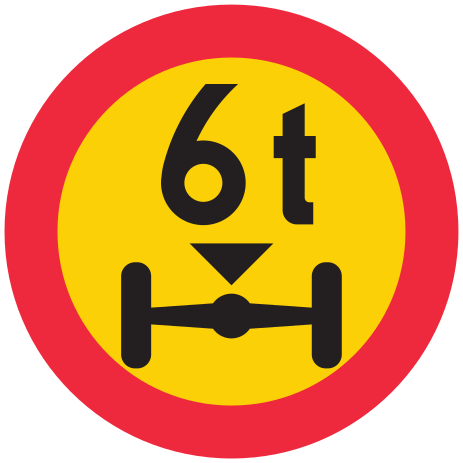
On BK2 the bogie load at the same axle distance is no more than 16 tonnes, and on BK3 both axle and bogie loads are even lower. The axle load sign applies to each individual axle, not to the vehicle's total weight.
Coupling distance
The distance between the trailer's first axle and the towing vehicle's last axle is called the coupling distance (kopplingsavstånd). If both are single axles, the distance must be at least 3 metres. When both axles are part of a bogie each, at least 4 metres is required. On BK2 and BK3, 4 metres is required as soon as a single axle meets a bogie, and some combinations with a triple axle require 5 metres.
The registration certificate is your tool
Axle distances, gross vehicle weight and permitted axle loads are stated in the registration certificate (registreringsbeviset). That is where you find the information you need to work out how much you may load. Remember that all the limits apply at the same time. Even if the axle loads would allow more, you may never exceed the vehicle's gross vehicle weight or the road's bearing capacity class.
What happens if you overload?
Overloading (överlast) damages roads and bridges, makes the vehicle less safe and causes more wear on the vehicle. As the driver you can also be fined. The braking distance becomes longer and the vehicle behaves differently in bends when it is overloaded.
Remember
- Gross vehicle weight is stated in the registration certificate; gross weight is what the vehicle actually weighs right now.
- The maximum width is 2.60 metres, and the load may not stick out more than 20 cm to the side.
- The maximum length is 24.0 metres, or 25.25 metres if the conditions are met.
- There is no general height limit, but you are responsible for knowing the vehicle's height.
- A public road is BK1 unless otherwise decided. BK4 allows a maximum of 74 tonnes, BK1 64 tonnes and BK2 51.4 tonnes. BK3 has the lowest weights.
- On BK1 a driving axle may carry no more than 11.5 tonnes and a non-driving axle no more than 10 tonnes.
- The gross weight sign applies to the actual weight, not the gross vehicle weight.