Chapter 10 · Traffic rules · 7 min
Pedestrians, cyclists and other vulnerable road users
Pedestrians, cyclists, moped riders and horse riders have no car body to protect them. If something goes wrong, they are almost always the ones who get hurt. As a car driver you therefore have a special responsibility, and the traffic rules give them priority in many situations.
Pedestrian crossings
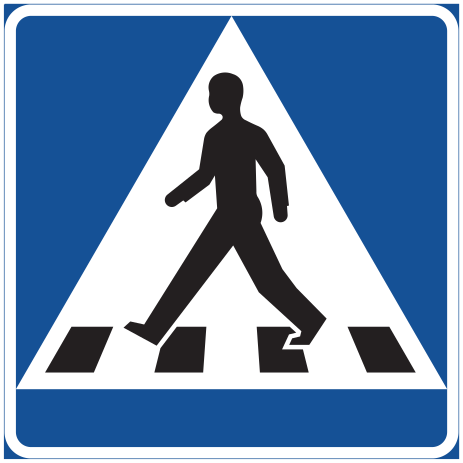
Uncontrolled pedestrian crossing
An uncontrolled pedestrian crossing (obevakat övergångsställe) has no traffic signal and no police officer. There you have a duty to give way (väjningsplikt) to pedestrians who have stepped onto the pedestrian crossing or who are just about to step onto it (Traffic Ordinance (trafikförordningen) 3 kap. 61 §). So you do not need to wait until the person is standing in the road. If you see someone who is clearly about to step out, you must stop.
Controlled pedestrian crossing
A controlled pedestrian crossing (bevakat övergångsställe) is controlled by a traffic signal or a police officer. Follow the signal, but if a pedestrian has stepped out correctly, you must give them the opportunity to cross (trafikförordningen 3 kap. 60 §). If you have turned at a junction and are going to pass a controlled pedestrian crossing, you must drive at low speed and have a duty to give way to pedestrians crossing (trafikförordningen 3 kap. 60 §). So a green light for you may also mean green for the pedestrians you are turning past.
When you approach
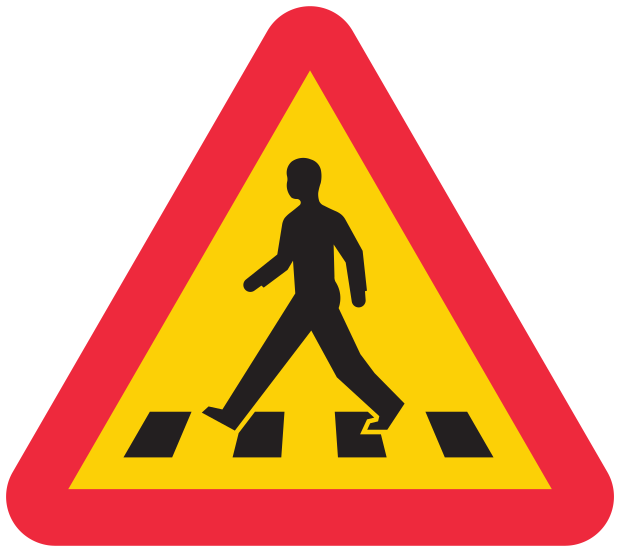
You must adapt your driving so that you are not forced to stop on the pedestrian crossing, the cycle passage (cykelpassage) or the cycle crossing (cykelöverfart) (trafikförordningen 3 kap. 62 §). Do not drive onto the pedestrian crossing if the queue in front is not moving.
It is prohibited to overtake immediately before or on an uncontrolled pedestrian crossing (trafikförordningen 3 kap. 40 §). Sometimes passing a car in the lane next to you does not count as overtaking, for example in a dense queue in all lanes. If you then pass another vehicle before a pedestrian crossing, you must keep your speed so low that you can stop immediately if there is a pedestrian on the crossing (trafikförordningen 3 kap. 41 §).
You may neither stop nor park on the pedestrian crossing or within 10 metres before it (trafikförordningen 3 kap. 53 §). A car parked there would block the view of the pedestrians.
Cyclists and moped riders
Cycle crossing and cycle passage
A cycle crossing (cykelöverfart) is a marked place where cyclists cross the road. At a cycle crossing you have a duty to give way to cyclists and class II moped riders who are on the crossing or are just about to ride onto it (trafikförordningen 3 kap. 61 a §). At a cycle passage (cykelpassage) cyclists do not have the same priority, but you must adapt your speed so that no danger arises for those who are on the passage. If you have turned at a junction or are leaving a roundabout and are going to pass an uncontrolled cycle passage, you must drive at low speed and let cyclists and moped riders who are on or just about to ride onto the passage cross (trafikförordningen 3 kap. 61 §).
The duty to give way when leaving an exit does not apply to cyclists and class II moped riders crossing the carriageway at a cycle crossing (trafikförordningen 3 kap. 21 §). So there it is they who have priority.
Cycle track
As a main rule, cyclists and class II moped riders must use the cycle track (cykelbana) if there is one (trafikförordningen 3 kap. 6 §). In some cases a cyclist may still ride on the carriageway, for example on streets with a low speed limit when it suits the journey better. So expect cyclists on the carriageway even where there is a cycle track. On the cycle track, other drivers must give them priority (trafikförordningen 3 kap. 59 §). This applies, for example, when you cross a cycle track to drive onto a property.
Overtaking a cyclist
When you overtake, you must leave a safe sideways distance (betryggande avstånd i sidled) (trafikförordningen 3 kap. 33 §). A cyclist may need to swerve for a hole, a branch or a gust of wind. If you cannot keep a proper distance, you will have to wait behind until you can.
Cyclists at junctions
Cyclists may keep to the right before a junction even when they are going to turn left. They cross the junction and only turn when it is safe (trafikförordningen 3 kap. 28 §). They may also overtake cars on the right-hand side (trafikförordningen 3 kap. 31 §). When you are going to turn right: check the right mirror and the blind spot, so that you do not run over a cyclist who is going straight ahead.
The door
Look in the mirror and over your shoulder before you open the car door. A cyclist hit by a door being opened can be thrown out into the carriageway.
Pedestrian street, pedestrian-priority zone and cycle street
There are areas where vulnerable road users have priority and the car is a guest.
- Pedestrian street (gågata): you may drive a motor vehicle there only to cross the street, or in certain cases, for example for deliveries, transporting residents or hotel guests and transporting sick people or people with reduced mobility. You may not drive faster than walking pace (gångfart), you have a duty to give way to pedestrians and you may not park outside places specially arranged for parking.
- Pedestrian-priority zone (gångfartsområde): you may drive there, but not faster than walking pace. You have a duty to give way to pedestrians and here too you may not park outside specially arranged places.
- Cycle street (cykelgata): at most 30 km/h, and as a car driver you must adapt your speed to the cyclists. Anyone who drives onto a cycle street has a duty to give way to vehicles already on the cycle street. Parking is only permitted in specially arranged places.
The rules for pedestrian streets, pedestrian-priority zones and cycle streets are in trafikförordningen 8 kap. 1 och 1 a §§. The duty to give way to pedestrians also applies on footpaths and roads for pedestrians, and when you drive out onto the road from a property exit (trafikförordningen 3 kap. 58 §). When you drive out from a pedestrian street, a pedestrian-priority zone or a cycle street, you have a duty to give way to traffic on the road you are driving out onto (trafikförordningen 3 kap. 21 §).
Children
Children are hard to see and hard to predict. They often judge speed and distance less well than adults and may suddenly run out after a ball or a friend. When you approach children on or by the road, you must keep a low speed (trafikförordningen 3 kap. 15 §).
The same applies when you approach a bus or school transport (skolskjuts) that has stopped to let passengers off or on. Children may appear in front of or behind the bus.
Elderly people and people with disabilities
An elderly person may need more time to cross the road. A person with impaired sight or hearing may not notice your car. Be patient, and do not sound the horn to hurry someone who is crossing.
Darkness makes vulnerable road users invisible
Trafikverket (the Swedish Transport Administration) states that a pedestrian in dark clothes and without a reflector is visible only at a distance of 20–30 metres to a motorist using dipped headlights. In light clothes they are visible at about 60 metres, and with a reflector at about 125 metres. Compare that with the stopping distance, which at 70 km/h is about 56 metres. In darkness you must therefore assume that there may be people on the road whom you will not see until it is too late, unless you adapt your speed.
Animals and horse riders
Keep a low speed when you approach livestock on the road (trafikförordningen 3 kap. 15 §). Horses can be frightened by noise and sudden movements. Slow down in good time, pass at a wide distance and avoid sounding the horn or revving the engine.
Remember
- At an uncontrolled pedestrian crossing you give way to pedestrians who are about to step out, not only to those who are already on it.
- No overtaking immediately before or on an uncontrolled pedestrian crossing, and no stopping within 10 metres before it.
- At a cycle crossing you have a duty to give way to cyclists and class II moped riders who are on or just about to ride onto the crossing.
- Leave a good sideways distance when overtaking cyclists.
- On a pedestrian street and in a pedestrian-priority zone, walking pace and a duty to give way to pedestrians apply.
- In darkness, a pedestrian in dark clothes is visible only at 20–30 metres. Adapt your speed.