Chapter 7 · Traffic safety · 7 min
Speed and distance
Speed affects almost everything in traffic: how much you have time to see, how long you have to react, how far the car travels before it stops and how hard the impact is if something goes wrong. That is why this is one of the most important chapters in the whole theory course.
The basic rule: adapt your speed
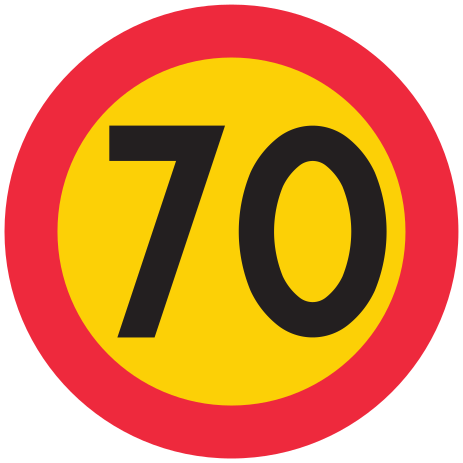
The sign states the maximum permitted speed, not the recommended speed. Your speed must always be adapted to what road safety requires. It must never be higher than allows you to keep control of the car and to stop within the distance you can see ahead and before any obstacle that can be foreseen (Traffic Ordinance (trafikförordningen) 3 kap. 14 §).
This means, for example, that in darkness you must be able to stop within the distance lit up by your headlights, and that before a blind crest you must be able to stop if there is a car on the other side.
When you must keep a particularly low speed
The Traffic Ordinance lists a number of situations where you must keep a sufficiently low speed (trafikförordningen 3 kap. 15 §). They include:
- within a built-up area (tättbebyggt område),
- when visibility is reduced by light or weather,
- at pedestrian crossings and other places where pedestrians cross the road,
- where crossing traffic may occur,
- on sharp bends and at crests of hills where visibility is obstructed,
- when there is a risk of dazzle,
- when meeting oncoming traffic on narrow roads,
- on slippery roads,
- when you approach a bus, tram or school transport that has stopped to let passengers off and on,
- when you approach children on or beside the road,
- at roadworks and past the scene of an accident.
Too low a speed
Nor may you, without a valid reason, drive at an excessively low speed or brake suddenly so that you obstruct others (trafikförordningen 3 kap. 16 §). So adapting your speed means choosing the right speed for the situation, not always the lowest.
The speed limits
Unless otherwise signed, the following applies (trafikförordningen 3 kap. 17 §):
- 50 km/h within a built-up area,
- 70 km/h outside a built-up area. This is called the basic speed (bashastighet).
Within a built-up area the municipality may decide that the limit is to be 30 or 40 km/h, and Trafikverket (the Swedish Transport Administration) may decide that the limit on a road is to be 80, 90, 100 or 110 km/h (trafikförordningen 3 kap. 17 §). Other limits are set in local traffic regulations (lokala trafikföreskrifter): by the municipality within built-up areas and on roads the municipality maintains, and by the county administrative board (länsstyrelsen) on public roads outside built-up areas. According to Trafikverket, limits have been possible in every step of ten between 30 and 120 km/h since 2008. On a motorway (motorväg), 110 km/h applies unless otherwise signed (trafikförordningen 9 kap. 1 §), and on some stretches the limit is signed as 120 km/h.
Car with a trailer
Lower speeds apply when towing a trailer (släpvagn). The rules are in trafikförordningen 4 kap. 20 §, which gets a new wording on 1 December 2026 (SFS 2026:1052). For a car with one trailer, under the new wording it is, in short, as follows:
- Braked trailer with brakes operated from the car's service brake: at most 80 km/h.
- Trailer with overrun brake (påskjutsbroms) (the usual brake on car trailers), a non-articulated drawbar and a gross weight (totalvikt) of at most 3.5 tonnes: at most 80 km/h.
- Unbraked trailer whose gross weight, or kerb weight (tjänstevikt) if it is unladen, is at most half of the car's kerb weight and at most 750 kg: at most 80 km/h.
- Other trailers, for example an unbraked trailer heavier than that or a trailer with an articulated drawbar: at most 40 km/h, if the trailer's actual weight (bruttovikt, what it actually weighs) is not higher than the car's.
- In other cases, for example when the trailer weighs more than the car: at most 30 km/h.
Transportstyrelsen's (the Swedish Transport Agency's) description of the rules that apply before 1 December gives the same limits of 80 and 40 km/h for ordinary trailers and caravans. If a lower limit is signed, that is of course the one that applies.
Why speed matters so much
Trafikverket states that the risk of dying falls by 40 per cent if a crash happens at 80 km/h instead of 90 km/h. Small differences in speed therefore make big differences in the consequences. At the same time, you rarely save more than a minute or so on an ordinary journey by driving faster.
The stopping distance
The stopping distance (stoppsträckan) is the distance the car travels from when you notice a hazard until the car is stationary. It consists of two parts:
- The reaction distance (reaktionssträckan): the distance you drive before you have started to brake. It grows at the same rate as the speed. If you drive twice as fast, it becomes twice as long.
- The braking distance (bromssträckan): the distance from when the brakes take effect until the car is stationary. It grows roughly with the square of the speed. If you drive twice as fast, it becomes roughly four times as long.
Trafikverket gives these examples for good tyres, good road conditions and good weather:
| Speed | Stopping distance |
|---|---|
| 30 km/h | approx. 17 m |
| 50 km/h | approx. 35 m |
| 70 km/h | approx. 56 m |
| 100 km/h | approx. 97 m |
Think about what the table means in practice. If a child runs out 17 metres in front of you, you have time to stop at 30 km/h. At 50 km/h, according to Trafikverket, you have not even started braking within the same distance, and you hit the child at 50 km/h.
The stopping distance becomes considerably longer with, for example, worn tyres and ice on the road. It also becomes longer if you are tired, distracted or under the influence, because your reaction time increases.
Distance to the vehicle in front
The distance to the vehicle in front must be adapted so that there is no risk of running into it if it slows down or stops (trafikförordningen 3 kap. 2 §). The law does not state a fixed measure.
The three-second rule
A simple way of checking the distance is the three-second rule (tresekundersregeln). Choose a fixed object by the road, for example a sign. When the car in front passes it, start counting: "one thousand and one, one thousand and two, one thousand and three". If you reach the object before you have finished counting, you are too close.
The rule is a rule of thumb, not a legal requirement. Three seconds is enough in good conditions. On slippery roads, in rain, in darkness or when you are towing a trailer, you need considerably more.
Someone is too close behind you
If the car behind is too close, there is not much you can do about that driver, but you can give yourself more margin. Increase the distance to the car in front, so that you can brake more gently if something happens. Let anyone in a hurry get past.
Remember
- The sign shows the maximum permitted speed. You must always be able to stop within the distance you can see.
- 50 km/h in a built-up area and 70 km/h outside, unless otherwise signed.
- Car with a braked trailer: at most 80 km/h. With an unbraked trailer, the limit (80, 40 or 30 km/h) depends on the trailer's weight.
- The braking distance grows roughly with the square of the speed: double the speed gives four times the braking distance.
- The stopping distance at 50 km/h is roughly twice as long as at 30 km/h.
- Keep at least three seconds' distance, and more in poor road conditions.