Chapter 11 · Traffic safety · 8 min
Darkness, slippery roads, weather and accidents
In Sweden we drive in darkness, cold and wet weather for a large part of the year. That makes different demands than a sunny summer's day. This chapter is about seeing and being seen, about road conditions and wildlife, and about what you do if an accident happens anyway.
Lights
When you drive on a road, the car's required lamps and headlights must be switched on (Traffic Ordinance (trafikförordningen) 3 kap. 68 §). In daylight, daytime running lights (varselljus) are enough. In darkness, dusk, dawn and bad weather, the dipped headlights and rear lights must be on. Many cars switch them on automatically, but not all, so check for yourself.
Motor vehicles must be driven with dipped headlights (halvljus) unless the rules on main beam, fog lights or other lights apply (trafikförordningen 3 kap. 69 §).
Main beam
Use main beam (helljus) when dipped headlights are not enough for you to drive safely at the speed you are keeping. You may not use main beam (trafikförordningen 3 kap. 70 §):
- when the road is sufficiently lit,
- so close to an oncoming vehicle that the driver may be dazzled,
- at a short distance behind another vehicle.
Dip your lights in good time when you meet someone, and switch the main beam back on immediately after passing.
Fog lights
In fog and in heavy rain or snowfall you may use fog lights (dimljus) instead of dipped headlights, but not at the same time (trafikförordningen 3 kap. 71 §). The rear fog light (dimbakljus) may only be used in fog, heavy precipitation or similarly poor visibility (trafikförordningen 3 kap. 72 §). It is very bright and can dazzle the driver behind you, so switch it off when visibility improves.
Darkness
In darkness you can only see as far as your headlights reach. The requirement to be able to stop within the distance you can see still applies (trafikförordningen 3 kap. 14 §). Dipped headlights do not reach very far, and according to Trafikverket (the Swedish Transport Administration) a pedestrian in dark clothes is visible only at 20–30 metres. That is shorter than the stopping distance at 70 km/h.
If you are dazzled by an oncoming car:
- Slow down.
- Look towards the right-hand edge of the road instead of straight into the light.
- Be prepared to stop if you cannot see.
Dirty headlights and windows reduce visibility a great deal. Wipe them regularly during the winter.
Slippery roads
Black ice
Black ice (svarthalka), also called flash ice (blixthalka), is particularly treacherous because it is often invisible. It can form when the road surface is cold and damp at temperatures around zero degrees, especially late in the evening and early in the morning. The road surface can be below zero while the air is still above. Bridges, viaducts, places near water and shady sections are particularly exposed, according to Trafikverket.
Other kinds of slippery conditions
- Frost (frosthalka) forms when moisture freezes on a snow-free road, often at dawn after a cold, clear night.
- Ice (ishalka) comes from freezing rain or rain that freezes when it reaches the cold road.
- Patchy ice (fläckvis halka) can form when meltwater freezes at night.
- Snow (snöhalka): even a little snow can make the road slippery.
How to drive on slippery roads
- Slow down and keep a longer distance to the vehicle in front.
- Brake, accelerate and steer smoothly. Sudden movements make the tyres lose their grip.
- Expect slippery conditions to appear suddenly, for example on a bridge after a dry stretch.
- If the car has ABS, you can brake hard and steer around an obstacle at the same time. Do not release the brake when the pedal vibrates.
- If you have summer tyres and there are winter road conditions: leave the car at home.
Winter tyres are required from 1 December to 31 March when there are winter road conditions (vinterväglag) (trafikförordningen 4 kap. 18 a §). There is more about tyres in the chapter about the car.
Rain and aquaplaning
On a wet road, grip is poorer and the stopping distance longer. If there is water in the wheel ruts, the tyres can start to slide on top of the water. This is called aquaplaning (vattenplaning), and then you can neither steer nor brake. The risk increases with speed and with worn tyres. If you notice that the steering feels light: ease off the accelerator carefully and keep the steering wheel straight until the tyres regain their grip.
Wildlife
You can meet wildlife (vilt) and reindeer on the road all year round, but according to Trafikverket the risk is greater in spring, when last year's calves are driven away, and in autumn, when elk (moose) and other wildlife move around more. Be particularly alert at dawn and dusk. If you see one animal, more may follow.
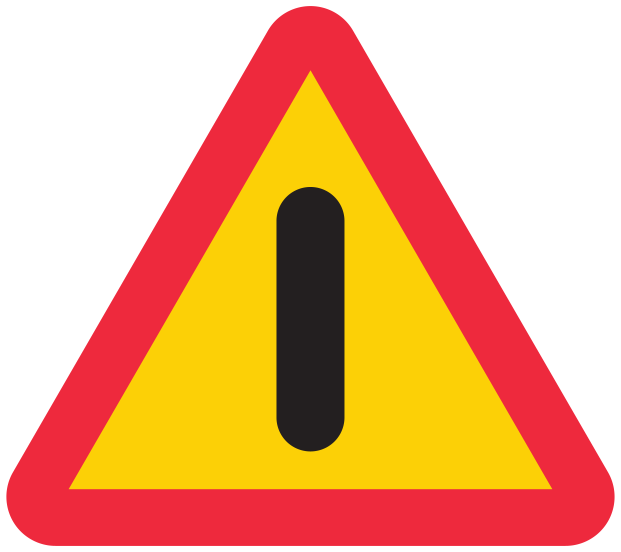
After a wildlife accident
- Call 112 and report the accident. This applies even if you are unsure whether the animal was injured.
- Put out the warning triangle.
- Mark the place where the animal disappeared, with a wildlife accident marker tape (viltolycksremsa) if you have one, so that a tracking hunter can find the spot. Mark the place even if the animal is dead.
- If you have collided with a wild boar, bear, lynx or wolf: drive about 200 metres further before you stop, mark the place and call the police immediately. These animals can be dangerous. The National Wildlife Accident Council (Nationella viltolycksrådet) states that the marking strip is then placed about 100 metres from the accident site.
- Never try to search for an injured animal yourself. The animal's suffering can get worse. The search is carried out by hunters with a tracking dog.
If you break down
If the car stops on a road with a speed limit higher than 50 km/h, where stopping is not permitted, you must put out the warning triangle (trafikförordningen 3 kap. 57 §). Trafikverket's advice is warn, leave, alert (varna, lämna, larma): hazard warning lights on and the triangle at least 100 metres behind the car, walk away from the road and preferably stand behind the crash barrier, call a breakdown service and, if there is danger to life, 112.
At a road traffic accident
Your obligations
If you have been involved in a road traffic accident, whether it was your fault or not, you must stay at the scene. You must, as far as you are able, help injured people and assist with what the accident reasonably requires. If someone who was involved or whose property was damaged asks for it, you must give your name and address and tell them what happened (trafikförordningen 2 kap. 8 §).
Anyone who leaves the scene of the accident and thereby evades their obligations can be convicted of leaving the scene of an accident (smitning) and sentenced to a fine or imprisonment for at most six months, or in serious cases imprisonment for at most one year (Act on Penalties for Certain Traffic Offences (lagen om straff för vissa trafikbrott) 5 §).
Make the scene safe
- Stop at a safe distance and switch on the hazard warning lights.
- Put out the warning triangle so that others are warned in good time.
- Call 112. Say where you are, what has happened and how many people are injured.
First aid according to L-ABC
Work in this order, where whatever threatens life most quickly comes first:
- L – Life-threatening situation (livsfarligt läge): is there a risk of further accidents, fire or traffic? Move the injured person only if it is necessary.
- A – Airway (andningsväg): make sure the airway is clear.
- B – Breathing (andning): is the person breathing normally?
- C – Circulation and bleeding (cirkulation och blödning): stop major bleeding.
Unconscious but breathing normally: place the person in the recovery position (stabilt sidoläge) and tilt the head back so that the airway is kept open. Stay until help arrives.
Unconscious and not breathing normally: call 112 immediately and assume it is cardiac arrest. Give cardiopulmonary resuscitation (hjärt-lungräddning, HLR) with 30 chest compressions and 2 rescue breaths in sequence. Use a defibrillator (hjärtstartare) if there is one.
Major bleeding: press hard directly on the wound with straight arms and keep up the pressure until medical staff ask you to let go. Do not remove objects stuck in the wound. Let the injured person lie down and keep them warm.
Remember
- Dipped headlights are the basic rule. Dip your lights in good time when meeting and behind other vehicles.
- Rear fog light only in fog or heavy precipitation, and switch it off when visibility improves.
- Black ice cannot be seen. Bridges, shady sections and places near water freeze first.
- Be extra alert for wildlife at dawn and dusk. Always call 112 after a wildlife accident.
- If you have been involved in an accident, you must stop, help and give your name and address.
- First aid: L-ABC. Recovery position if the person is breathing, CPR 30:2 if not.