Chapter 9 · Traffic rules · 7 min
Motorways, country roads and level crossings
When you leave town, driving changes. Speeds become higher, distances longer and new situations arise: slip roads, hard shoulders, wildlife and level crossings. In this chapter we go through the rules that apply there.
Motorway
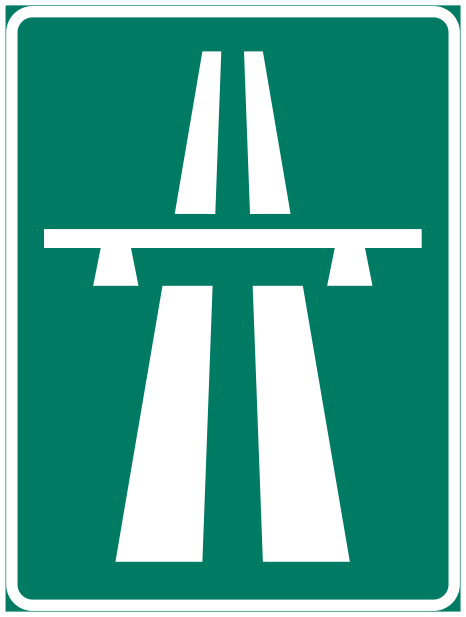
The motorway (motorväg) is built for fast traffic. The carriageways are separated, there are no junctions on the same level and traffic enters and leaves via slip roads. This requires everyone to follow the special rules that apply there.
Who may drive there?
Only motor vehicles, with or without a trailer, may be on a motorway, and only those that are designed for and permitted to be driven at at least 40 km/h. Class I mopeds (moped klass I) may not drive there (Traffic Ordinance (trafikförordningen) 9 kap. 1 §). You may only enter the motorway where it begins or via a slip road (påfart), and only leave it via an exit (avfart) or where it ends. So pedestrians, cyclists and class II moped riders do not belong on the motorway either.
Prohibited on a motorway
- Stopping and parking, except at places signed as a parking area or rest area (trafikförordningen 9 kap. 1 §).
- Turning round and reversing (trafikförordningen 9 kap. 1 §). If you have missed your exit, drive on to the next one.
Speed
The maximum permitted speed on a motorway is 110 km/h, unless otherwise signed (trafikförordningen 9 kap. 1 §). On some stretches the limit is signed as 120 km/h, on others lower. Lower speeds apply with a trailer; see the chapter on speed.
Joining
The slip road often ends in an acceleration lane (accelerationsfält). There you must adapt your speed to the traffic in the lane you are going to enter, and leave the acceleration lane as soon as it can be done without danger or unnecessary obstruction (trafikförordningen 3 kap. 23 §).
- Look in the mirror and over your shoulder early.
- Indicate and build up your speed. Pulling out at 60 km/h in front of cars doing 110 km/h is dangerous.
- Look for a gap and glide into it.
If there is no acceleration lane, you have a duty to give way (väjningsplikt) to traffic on the motorway, unless you can join without changing lanes (trafikförordningen 3 kap. 21 §).
Traffic on the motorway also has a responsibility. A driver who notices that someone wants to move into their lane must adapt their speed to make it easier for the other driver to move in (trafikförordningen 3 kap. 43 §). Moving to the left lane when possible is a good way to help, but it is not a requirement.
Leaving
Move into the right lane in good time and use the deceleration lane (retardationsfält) to reduce your speed, not the motorway lane (trafikförordningen 3 kap. 23 §). Check the speedometer after the exit. After a long time at high speed, 70 km/h often feels slower than it is.
Keep to the right
Drive in the right lane and use the left lane for overtaking (trafikförordningen 3 kap. 7 §). Cars that stay in the left lane force others to overtake on the right or to drive too close.
When the motorway ends
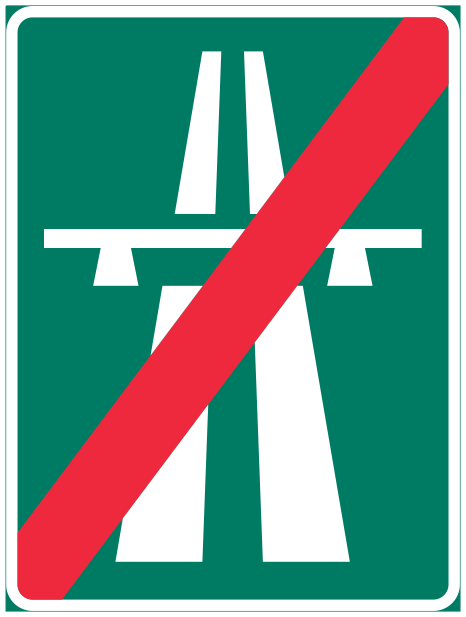
The end of motorway sign (motorväg upphör) shows that the special motorway rules stop applying. After that there may be junctions, cyclists and lower speed limits. Slow down in time.
Expressway
An expressway (motortrafikled) has its own sign and resembles a motorway, but the standard is often lower. The rules on who may drive there and the prohibitions on stopping, parking, turning round and reversing also apply, where relevant, on an expressway (trafikförordningen 9 kap. 2 §). The speed limit is shown by the signs.
Country road
Outside a built-up area the basic speed (bashastighet) is 70 km/h unless otherwise signed (trafikförordningen 3 kap. 17 §). Many country roads (landsvägar) have higher signed limits, but bear in mind that bends, crests, narrow sections and a poor hard shoulder may require a lower speed than the sign allows (trafikförordningen 3 kap. 14 §).
The hard shoulder
The hard shoulder (vägrenen) is used by cyclists, class I moped riders and slow vehicles. You may use the hard shoulder temporarily to let faster traffic past (trafikförordningen 3 kap. 12 §). Then watch out for cyclists and pedestrians who may be there, especially in darkness.
Stopping off the carriageway
Outside a built-up area you must stop or park off the carriageway if possible. A car standing on the carriageway where speeds are high can be difficult to spot in time.
If the car stops on a fast road
Trafikverket (the Swedish Transport Administration) sums it up in three words: warn, leave, alert (varna, lämna, larma).
- Warn (varna): switch on the hazard warning lights. Put out the warning triangle at least 100 metres behind the car, preferably further. The triangle must be put out where the speed limit is higher than 50 km/h and where stopping is not permitted (trafikförordningen 3 kap. 57 §).
- Leave (lämna): walk away from the road, preferably behind the crash barrier if there is one. It is not safe to stay in the car.
- Alert (larma): call a breakdown service. If there is danger to life, always call 112.
Level crossing
A collision with a train is almost always serious. A train cannot swerve and needs a very long distance to stop. You must therefore always give way to trains, and to trams unless a road sign gives the tram a duty to give way (trafikförordningen 2 kap. 5 §).
The signs
- Warning sign for a level crossing with barriers and without barriers are placed before the crossing.
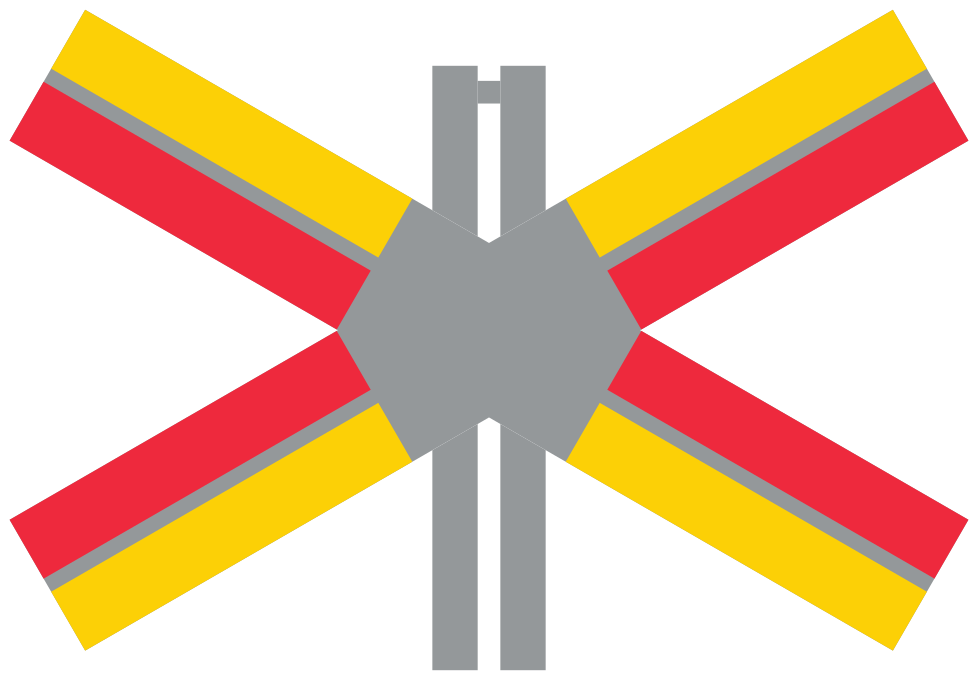
- The St Andrew's cross (kryssmärket) stands immediately before the crossing itself. It shows a crossing with a railway or tramway, with one or more tracks (Road Signs Ordinance (vägmärkesförordningen) 2 kap. 5 §).
Rules at the crossing
Anyone who is going to cross a railway or tramway must be particularly careful. You must adapt your speed so that you can stop before the crossing and then cross without unnecessary delay (trafikförordningen 2 kap. 7 §).
You may not drive onto the crossing if (trafikförordningen 2 kap. 7 §):
- a train or tram is approaching,
- the light signal shows red or the sound signal is sounding,
- the barriers are down or are being lowered or raised,
- there is a risk that you will have to stop on the crossing, for example because of a queue.
If you may not drive onto the crossing, you must stop at a safe distance, before the signals and barriers (trafikförordningen 2 kap. 7 §).
More rules around the crossing
- You may not stop or park on a level crossing (trafikförordningen 3 kap. 47 §).
- You may not park within 30 metres of a level crossing (plankorsning) (trafikförordningen 3 kap. 55 §).
- You may not overtake immediately before or on a level crossing, except when it has barriers or traffic signals (trafikförordningen 3 kap. 39 §).
If you get stuck on the track
If the car stops on the track: leave the car immediately with all passengers and move away from the track. Then call 112. Do not try to save the car if a train may be coming.
Bear in mind
- Never assume the line is clear just because you cannot hear anything. Modern trains are quiet and fast.
- If a train has just passed, another one may come from the other direction. Wait until the signals have gone out and the barriers have gone up completely.
- Slow down and look both ways even at crossings without barriers and lights.
Remember
- On a motorway you may not stop (except at a rest area), turn round or reverse.
- Use the acceleration lane to reach the same speed as the traffic and the deceleration lane to brake.
- If the car stops on a fast road: warn, leave, alert. The triangle at least 100 metres behind.
- At a level crossing you must be able to stop before the crossing and then cross without delay.
- Never drive onto the crossing at a red light, sound signal, lowered barriers or if you risk being left standing on the track.
- No parking within 30 metres of the level crossing and no overtaking before a crossing without barriers or signals.