Chapter 4 · Traffic rules · 7 min
Road markings and traffic signals
The lines on the road and the lights in traffic signals control traffic just as much as the signs do. In this chapter we go through the most common markings, what the colours of the signals mean and how you show others what you intend to do.
White and yellow markings
Road markings (vägmarkeringar) are white unless otherwise stated (Road Signs Ordinance (vägmärkesförordningen) 4 kap. 3 §). There are two kinds of yellow markings.
Temporary yellow markings are used when there is a temporary need, for example at roadworks, and then apply instead of the ordinary markings (vägmärkesförordningen 4 kap. 3 §). If there are both white and yellow lines, it is the yellow ones that apply.
Yellow lines at the edge of the carriageway are permanent and show a ban on stopping or parking:
- Solid yellow line (M21): no stopping or parking.
- Broken yellow line (M22): no parking. The marking is also used to show how far a bus stop extends.
- M23 is used to reinforce the ban shown by M21 or M22.
The colour of these markings may not be changed.
Longitudinal lines
Centre line and lane line
A centre line (mittlinje) separates lanes for traffic in opposite directions. A lane line (körfältslinje) separates lanes for traffic in the same direction (vägmärkesförordningen 4 kap. 4 §). Both are usually broken, which means that you may cross them when it is safe, for example when overtaking or changing lanes.
Edge line
An edge line (kantlinje) shows where the carriageway ends (vägmärkesförordningen 4 kap. 4 §). Outside the edge line is the hard shoulder (vägrenen).
Warning line
A warning line (varningslinje) has longer dashes and shorter gaps than an ordinary centre line. It means that it is unsuitable to cross the line with regard to road safety (vägmärkesförordningen 4 kap. 4 §), for example because visibility is limited further ahead. So the line is a warning, not a prohibition. If you see a warning line, you should assume that overtaking is probably not safe.
Solid line
A solid line (heldragen linje) is used instead of a broken line where, for safety reasons, it is not permitted to cross it, change lanes or drive out onto the hard shoulder (vägmärkesförordningen 4 kap. 6 §). The rules in the Traffic Ordinance (trafikförordningen) are clear:
- If a solid line separates the lanes, you may not change lanes (trafikförordningen 3 kap. 9 §).
- No wheel may be driven over a solid line or into a hatched area (trafikförordningen 3 kap. 11 §). There are exceptions, for example when you must pass an obstacle on the road, but then you must be particularly careful.
Sometimes there is a solid line and a broken line next to each other. Then the line closest to you applies. If you have the broken line on your side you may cross; if you have the solid line you may not.
Hatched area
A hatched area (spärrområde) is a surface with diagonal stripes, often where lanes divide or at a traffic island. No vehicles may be driven there (vägmärkesförordningen 4 kap. 6 §).
Transverse lines
- Stop line (stopplinje): a solid transverse line showing where you must stop at a stop sign or a red light (vägmärkesförordningen 4 kap. 8 §).
- Give way line (väjningslinje): a broken transverse line, often with triangles ("shark's teeth", hajtänder), showing the line you should not pass when giving way (vägmärkesförordningen 4 kap. 8 §).
Traffic signals
The traffic signal (trafiksignal) controls traffic with coloured lights. The meaning is fixed (vägmärkesförordningen 3 kap. 6 §):
| Signal | Meaning |
|---|---|
| Red | Stop. You may not pass the stop line, or the signal if there is no stop line. |
| Red and amber | It will soon be green. Otherwise it applies as red, so you may not go yet. |
| Green | You may go. A duty to give way may still apply, for example to pedestrians when you turn. |
| Amber | Stop. You may only continue if you are so close that you cannot stop safely. |
| Green arrow | You may go in the direction the arrow shows, even if another signal is lit at the same time. |
| Flashing amber | Drive with particular care. |
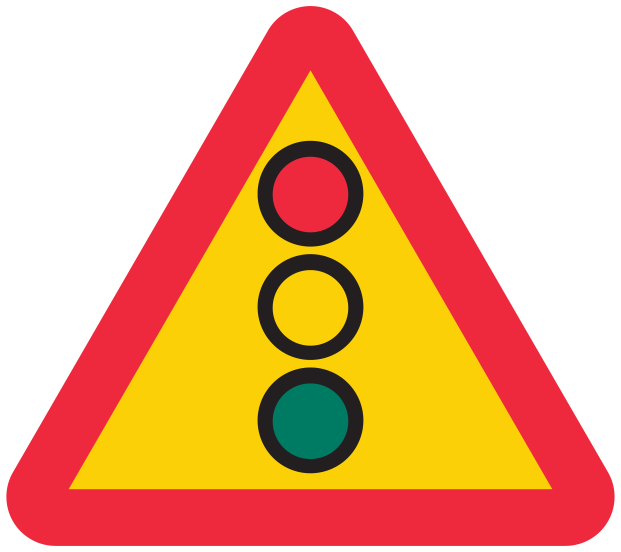
Amber does not mean "hurry up"
Amber means stop. The only exception is when you are already so close that hard braking would be dangerous. You should therefore adapt your speed when approaching a signal that has been green for a long time, so that you can stop calmly if it changes.
Signal and road sign at the same time
A steady light in a traffic signal takes precedence over a duty to stop or a duty to give way shown by a road sign (trafikförordningen 2 kap. 2 §). So if the signal is working normally, you follow the signal. If the signal is switched off or only flashing amber, it is the road signs, or otherwise the right-hand rule, that decide who has priority.
Signals for certain road users
There are special signals for, for example, cyclists, pedestrians and public transport. A special instruction for cyclists, class II moped riders or pedestrians applies to them before other instructions (trafikförordningen 2 kap. 2 §). As a car driver you must follow the signal directed at you.
Police and traffic controllers
You must obey a police officer's instruction for traffic. The police instruction takes precedence over the traffic rules and over signals, road signs and markings (trafikförordningen 2 kap. 3 §). So if a police officer waves you forward against a red light, you must drive.
At roadworks a traffic controller (vakt) may direct the traffic. The controller's stop sign means stop for the road user the controller is facing, and the "drive forward" signal means that you may continue (vägmärkesförordningen 5 kap. 2 §).
Giving signals yourself
Other road users cannot read your mind. You must therefore signal with your direction indicator (körriktningsvisare) when you intend to move off from the side of the road, turn, change lanes, turn round or otherwise move sideways. The signal must be given in good time, be clearly visible and impossible to misunderstand. When the manoeuvre is finished, the indicator must be switched off (trafikförordningen 3 kap. 65 §).
The brake lights are also a signal. Anyone intending to stop or to reduce speed quickly must show this with the brake light (trafikförordningen 3 kap. 65 §).
Having indicated does not give you any right to go. You must still make sure that the manoeuvre can be carried out without danger or unnecessary obstruction to others (trafikförordningen 3 kap. 66 och 43 §§). Check your mirrors and the blind spot before you change lanes or pull out from the kerb.
Sound and light signals
When it is needed to prevent or avert danger, you must give a sound or light signal, for example sound the horn or flash the main beam, or attract other road users' attention in some other suitable way. The signal must not be given for longer than necessary (trafikförordningen 3 kap. 64 §). The horn and the headlight flasher are therefore for warning, not for telling other road users off.
Remember
- A broken line may be crossed when it is safe. A solid line and a hatched area may not be crossed, except in special cases such as when you must pass an obstacle.
- A warning line means that it is unsuitable to cross, usually because of poor visibility.
- Temporary yellow markings take precedence over the white ones. A yellow line at the edge means no stopping (solid) or no parking (broken).
- An amber light means stop, except when you are so close that you cannot stop safely.
- Police instructions take precedence over signals, road signs and traffic rules.
- Indicate in good time, but always check that the manoeuvre is safe. The indicator does not give you priority.